



Business Central

Case Studies
Chemicals Manufacturing
Managing Formula Changes Without Losing Control
How chemical manufacturers can manage formulation change while protecting production, costing, and operational consistency.

True end-to-end batch traceability means being able to follow materials from supplier receipt through production, intermediate batches, finished goods, inventory movements, and ultimately to the customers who received the product.
For chemical manufacturers, traceability does not stop at knowing which raw material arrived on which purchase order. True end-to-end batch traceability means being able to follow materials from supplier receipt through production, intermediate batches, finished goods, inventory movements, and ultimately to the customers who received the product.
That level of visibility matters particularly in chemical manufacturing, where formulations can contain materials from multiple suppliers and lots, production can create intermediate products, and a quality issue may need to be traced both backward to its source and forward to determine its impact.
If a supplier notified you of a problem with a specific raw-material lot today, how quickly could your organization determine every batch, finished product, and customer potentially affected?
Many chemical manufacturers already capture significant amounts of production and quality information. The challenge is connecting it.
From an executive perspective, having the data somewhere is very different from being able to reconstruct a batch’s complete history quickly and confidently.
When these records are disconnected, a quality investigation can become an exercise in manually assembling the story of what happened.
The objective is to create an uninterrupted chain of information and, crucially, to be able to traverse that chain in both directions.
Supplier → Raw Material Lot → Production Batch → Intermediate/Finished Batch → Inventory → Customer Shipment
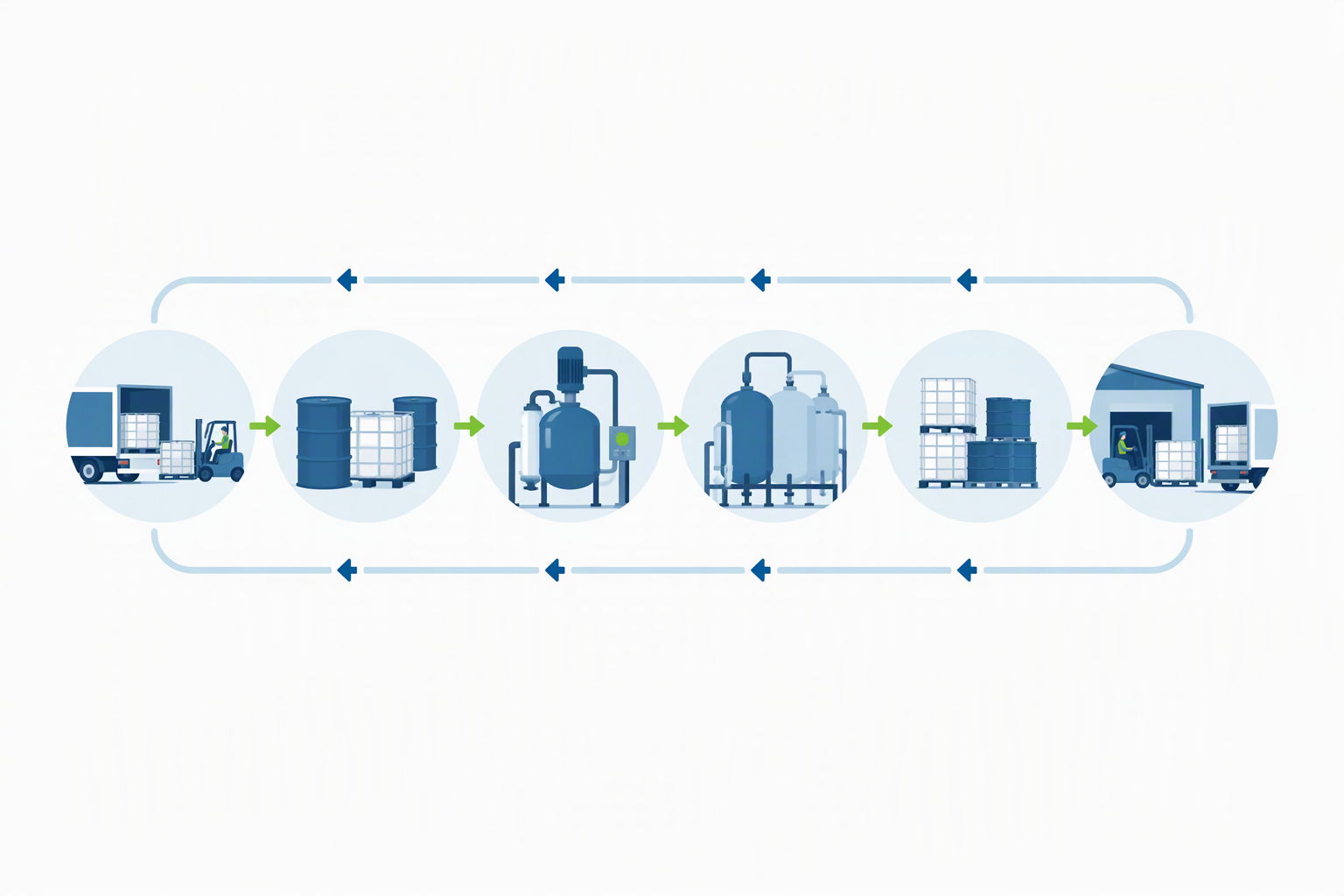
Imagine a customer raises a quality concern involving a finished chemical product. The manufacturer needs to determine:
Finished Product → Production → Raw Materials → Supplier
This is the finished product → raw material trace. The operational objective is to replace a manual investigation across multiple records with a connected transaction history.
A supplier reports that a particular lot of an ingredient may be defective or out of specification. Management now needs to understand the potential exposure:
Supplier Lot → Production → Finished Goods → Shipment → Customer
That distinction is important. Traceability isn’t simply about determining where something came from. It is also about understanding everywhere it went.
Traceability begins when material enters the business. Business Central lets organizations assign lot numbers to tracked materials on inbound transactions, establishing the starting point for connecting incoming material to everything that happens later.
For chemical manufacturers, supplier documentation, Certificates of Analysis (COAs), specifications, and quality results may also need to be connected to the corresponding material and lot.
Once material has been received, preserving its identity as it moves through inventory is critical. Lot-controlled inventory allows the organization to maintain the connection between a specific material lot and the inventory transactions associated with that material.
For chemical operations, disciplined lot control helps prevent the traceability chain from breaking between receiving, storage, warehouse movements, and production.
The next critical connection is consumption. The organization needs to know exactly which raw-material lots were consumed by which production batches.
Capturing a lot at receipt but losing that relationship when the material reaches production creates a major gap in batch genealogy. Consistent transaction discipline connects the ingredients consumed during production to the batches they helped create.
Finished production also needs a persistent lot or batch identity. Connecting the finished-product lot to the lot-tracked ingredients consumed during production establishes the core of batch genealogy.
That relationship is what makes it possible to trace backward from a finished batch to its components or forward from a suspect raw-material lot into subsequent production.
Traceability cannot stop when production ends. The finished-product lot identity needs to remain connected as material moves through inventory and ultimately to the customer.
Maintaining lot tracking through outbound transactions creates the final link between production genealogy and customer exposure, allowing the organization to determine which customers received products associated with a particular lot.

The value of end-to-end traceability extends beyond the quality department.
When genealogy is precise, organizations can investigate the specific lots and transactions associated with an issue rather than beginning with a broad search across production.
For executives, the important outcome is better information for determining the actual scope of exposure.
Backward and forward lot tracing can help manufacturers respond more effectively when a material or finished product may be affected by a quality issue or recall.
The objective isn’t simply being able to run a traceability report. It is being able to answer quickly: What was affected, where is it now, and who received it?
Customers increasingly expect suppliers to answer quality questions with confidence. A connected batch genealogy gives customer service, quality, operations, and management a common transactional foundation when researching an issue.
Instead of several departments producing different pieces of the answer, the organization can work from a connected history.
Connected batch genealogy helps investigators identify shared relationships across affected batches, including supplier lots, raw materials, formulas, production activity, equipment, and inventory movements.
The ERP doesn’t replace laboratory testing or quality expertise. It provides the transactional genealogy that lets teams understand relationships between materials, production, inventory, and shipments.
For chemical manufacturers, Business Central should be viewed as the transactional backbone of traceability rather than simply an accounting system.
Microsoft’s standard platform provides capabilities for:
However, executives should distinguish between ERP lot genealogy and the company’s complete quality-management requirements.
Depending on the operation, areas such as laboratory testing, COA management, specification control, batch release, formula management, regulatory documentation, or specialized process-manufacturing requirements may require additional Business Central configuration, extensions, integrations, or complementary systems.
The goal isn’t to force every process into ERP. The goal is to establish a reliable digital thread connecting the transactions that matter.
|
LOT TRACKING
|
END-TO-END TRACEABILITY
|
|---|---|
|
Do we record lot numbers?
|
Can we use those lot numbers to reconstruct what happened across the entire material and product lifecycle?
|
A company can technically have lot tracking and still struggle with traceability. The real value appears when purchasing, receiving, inventory, manufacturing, and shipping preserve those relationships consistently.
Can we identify exactly which supplier lot entered our inventory?
Can we identify which raw-material lots were consumed in a specific production batch?
Can we trace a finished batch backward through the materials used to produce it?
If a supplier identifies a suspect material lot, can we determine where that material was subsequently used?
Can we determine which customers received products associated with the lots under investigation?
Could our team answer these questions confidently during an urgent quality investigation without assembling information from multiple spreadsheets and paper records?
If several answers are “no,” the organization may have lot tracking without true end-to-end traceability.
End-to-end batch traceability is not just a compliance feature. For chemical manufacturers, it connects supply chain, manufacturing, inventory, quality, and customer service around a common view of material history.
Microsoft Dynamics 365 Business Central provides core lot-tracking and forward/backward tracing capabilities that can serve as the transactional foundation for that strategy. The strategic objective should be straightforward:
Know what went into every batch, know where every batch went, and be able to retrieve that information when the business needs it.
That is the difference between simply recording lots and building a traceability capability that helps protect customers, operations, and the business.
Naviona helps chemical manufacturers design the Microsoft Dynamics 365 Business Central processes, item-tracking controls, production transactions, integrations, and reporting needed to preserve batch genealogy from receiving through customer shipment.
The objective is not simply to activate lot tracking. It is to create a traceability process that works across purchasing, inventory, production, quality, warehousing, and customer service.








Whether you’re evaluating a new ERP platform, planning an upgrade, or improving your manufacturing operations, a Manufacturing Strategy Session can help identify opportunities to improve visibility, operational performance, and determine the right path forward.
