This case study reflects industry-wide practices, standards, and regulatory expectations as of August 2026. It is not attributed to a specific organization; scenarios and outcomes describe patterns commonly observed across plastics manufacturers.
End-to-end lot traceability has quietly become one of the most consequential capability gaps in plastics manufacturing. Across the U.S. plastics industry — which shipped approximately $25 billion in monthly product in 2025 and employs more than 587,000 people — cyclical volatility, tariff pressure, and customer consolidation have compressed margins and elevated the cost of every quality event.
In this environment, executives are discovering that the ability to answer one deceptively simple question determines whether a complaint becomes a contained investigation or a plant-wide recall.
Which resin lots are inside this part?
Which resin lots are inside this suspect part, and which customers received them?
This industry case study examines how plastics manufacturers as a group are transitioning from fragmented, paper-based lot records toward integrated, end-to-end genealogy. It highlights the operational challenges common to injection molders, extruders, blow molders, compounders, and thermoformers; the regulatory and customer forces driving investment; and the role that Microsoft Dynamics 365 Business Central plays as the operational backbone connecting procurement, production, warehousing, quality, and distribution. Rather than profiling a single company, this study reflects patterns observed across the industry — patterns that manufacturing executives can benchmark their own operations against.
The Industry Challenge: Why Traceability Has Become a Strategic Priority
An Industry Under Cyclical and Regulatory Pressure
The plastics industry entered 2026 operating in a squeeze. U.S. plastics revenue growth was projected to contract 4.8% and industry profitability to decline in 2025, while average capacity utilization fell from 67% to 53% in the Wipfli 2025 Manufacturing Pulse Study of more than 310 plastics and tooling facilities. Executives simultaneously face rising input tariffs on resin, steel, aluminum, and molding equipment — including August 2025 extensions that added tariffs to injection, blow, and compression molds.
At the same time, the regulatory and customer bar for traceability keeps rising. The EU’s Packaging and Packaging Waste Regulation (Regulation 2025/40) entered into force February 11, 2025, with key binding provisions applicable EU-wide starting August 12, 2026, introducing new requirements for recyclability, recycled content thresholds, and traceability across plastic packaging. In parallel, the FDA’s revised Quality Management System Regulation (21 CFR Part 820), effective February 2, 2026, now incorporates ISO 13485:2016 by reference — including its Clause 7.5.9 traceability requirements — for medical devices, many of which are plastic components.
The Economics of a Traceability Gap
A single Class I recall now averages $35 million in total economic impact, and direct recall costs for medical devices and pharmaceuticals routinely exceed $30 million — with an additional 5+ years of brand-trust damage when response is perceived as slow. Insured companies recover only 40–60% of total recall costs through insurance, funding the remainder from operating cash flow.
The single largest driver of recall cost is the time between defect introduction and recall initiation — every week of delay after a Class I signal is identified translates to additional product in distribution and additional regulatory exposure.
Manufacturers with weak resin lot traceability experience a compounding effect: because they cannot narrow exposure to specific lots or time windows, recalls become broad and expensive, and every resin complaint triggers a plant-wide panic.
What End-to-End Lot Traceability Really Means in Plastics
End-to-end lot traceability is the structured ability to answer two questions at any time. Forward: given a resin lot, which parts, batches, customers, and markets did it end up in? Backward: given a defective part or complaint, which resin lot(s) and suppliers contributed to it? In a plastics environment, this is more complex than pallet-in / pallet-out tracking because resin passes through bulk silos, shared dryers, manifolds, loaders, and regrind streams — meaning genealogy must be reconstructed months or years after production.
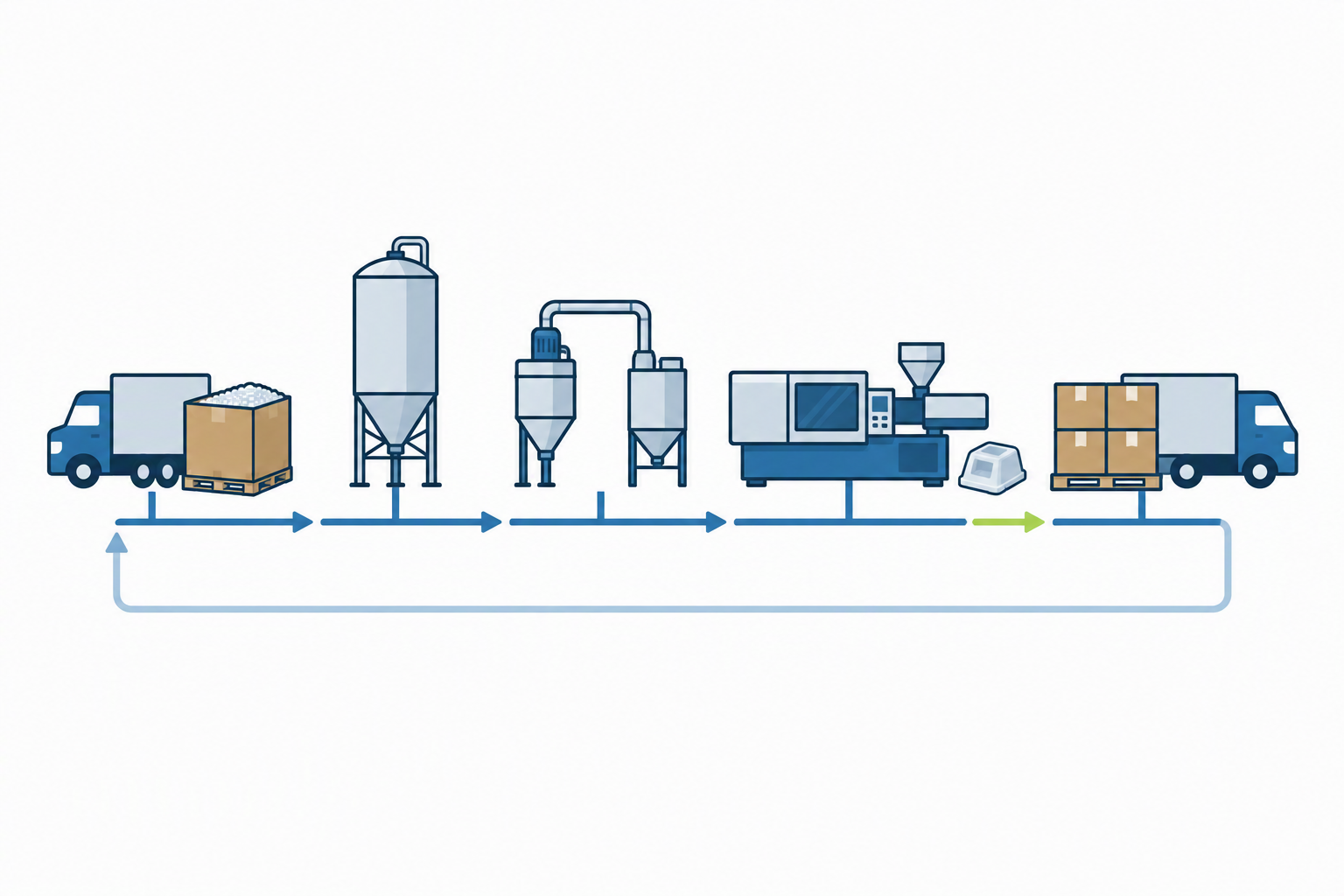
Raw Material Receiving → Bulk Storage → Internal Movements → Production → Downstream Distribution
A modern, defensible traceability model spans five operational layers, each of which introduces its own risk if it breaks the chain:
Raw material receiving: Capture supplier lot numbers, material codes, Certificate of Analysis (COA) references, and risk classes for every delivery, and assign internal lot IDs with GS1-128 or equivalent barcodes.
Bulk storage: Record which lots are loaded into which silos and Gaylords, with mixing models, “heels,” and segregation rules that avoid uncontrolled mixing of incompatible resin families.
Internal movements: Track loaders, manifolds, and day bins with time-stamped batch-to-bin events, so a wrong valve or hose move doesn’t invisibly cross-contaminate multiple jobs.
Production: Link resin lots to specific work orders, molds, cavities, purge and first-article approvals, and (for high-risk products) cavity- or lane-level attribution.
Downstream distribution: Maintain SSCC-level case and pallet labels linked to production lots, plus one-up/one-down traceability so a lot can be jumped from silo to customer shipment in seconds.
Common Traceability Challenges Across the Plastics Industry
Raw Material and Resin Tracking
Plastics manufacturers routinely handle hundreds of raw material variants — virgin polymers, masterbatches, additives, colorants, fillers, and reclaimed streams — under strict FIFO, shelf-life, and lot traceability rules. Material traceability begins with certification of virgin polymer sources, documentation of additives and processing aids, chain of custody for recycled materials, and lot-numbering systems that identify production batches and dates. When intake is sloppy — lots combined informally, labels missing, or supplier lot data not captured in ERP — traceability is broken before pellets ever reach a silo.
Regrind and Reclaimed Material Management
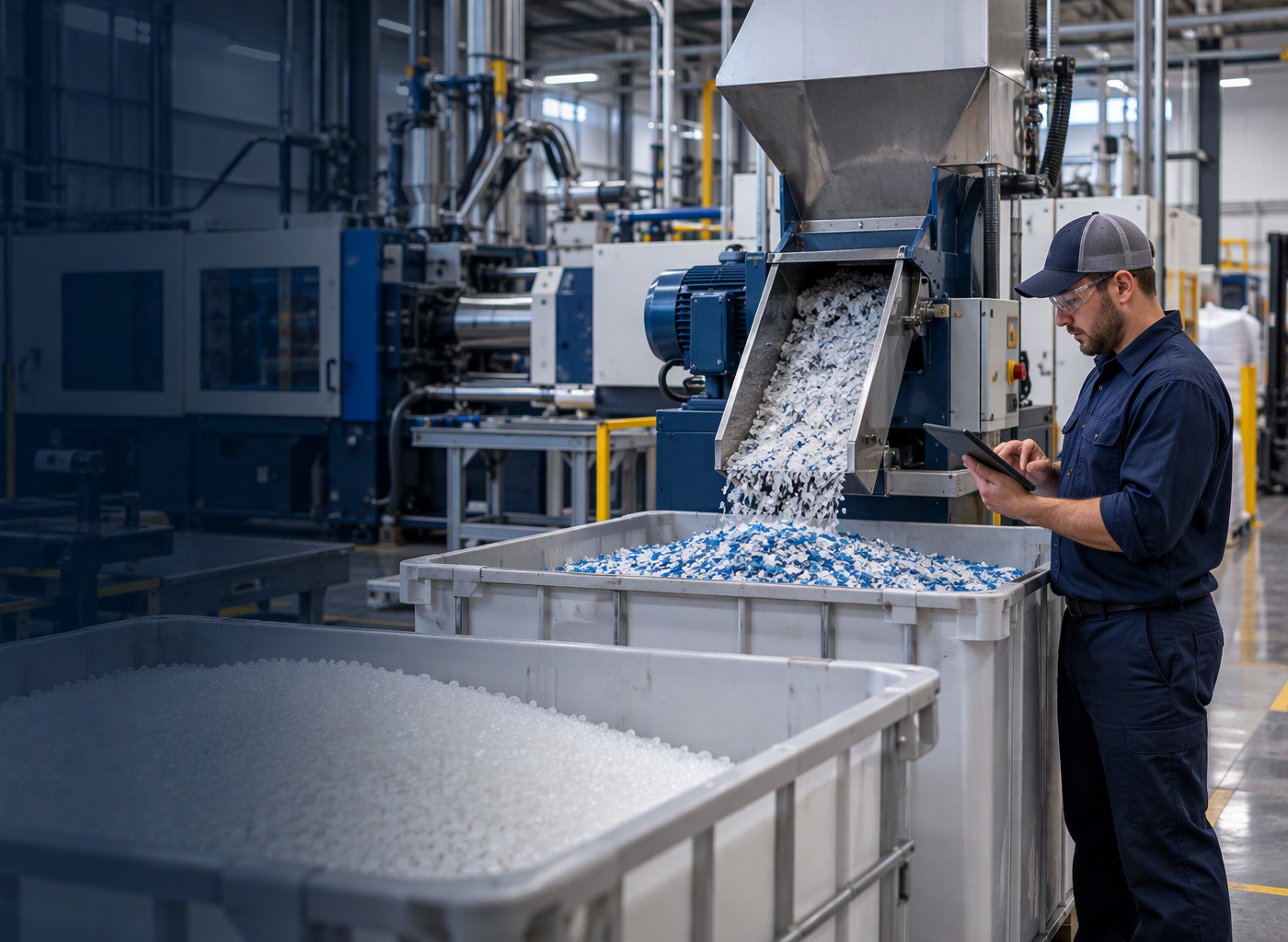
Regrind is uniquely challenging because it is plastics manufacturing waste (runners, rejects, scraps) that is ground and reused in-house during production, often blended with virgin resin at controlled percentages. Without disciplined tracking, executives lose cost visibility on virgin vs. regrind consumption, yield, margin erosion, and material accountability. Reclaimed post-consumer or post-industrial streams add a second layer of complexity because their upstream chain of custody must be documented for recycled-content claims — a growing PPWR compliance obligation.
Bulk Storage, Silos, and Hopper Behavior
Bulk storage is where many traceability stories fall apart. Effective resin lot traceability requires recording which lots are loaded into which silos or day bins, applying reasonable mixing and “heels” assumptions, and enforcing segregation rules that prevent uncontrolled blending of incompatible resin families in shared vessels. When a silo is treated as a generic “PC silo” with no lot history, the only honest answer to “which lot is in this part?” is “we don’t know” — an answer that is unacceptable in medical, automotive, and food-contact applications.
Quality Investigations and Root-Cause Analysis
When a customer alerts an injection molder to a part quality issue, the operational goal is to trace every step of the production process — from the machine, to the settings and specifications, to the material lots used to make the parts. Without integrated genealogy, this reconstruction consumes cross-functional teams for days and often ends in “we think” answers rather than definitive lot-level containment. Quality teams also lose the ability to correlate defects to specific materials, machines, operators, or process parameters — undermining continuous improvement.
Regulatory and Customer Compliance Expectations
Plastics manufacturers serve regulated sectors that each impose distinct traceability requirements:
Medical devices: Complete documentation from resin to finished device is required under 21 CFR Part 820 (QMSR) as amended in 2026, which now incorporates ISO 13485:2016 Clauses 7.5.8 (Identification) and 7.5.9 (Traceability).
Food packaging: Verification of food-grade materials and processing under FDA 21 CFR 177.1520 for polyolefins and EU Regulation 10/2011.
Automotive components: IMDS material data reporting and IATF 16949 quality management, tracking additives to the batch level.
Aerospace plastics: Extended traceability requirements with supplier qualification (typically AS9100D).
Packaging under EU PPWR: Recyclability, minimum recycled content thresholds, and material traceability enforceable from August 12, 2026.
Recall Readiness and Supply-Chain Visibility
Most brands currently only have visibility up to their Tier 1 suppliers, leaving significant blind spots regarding what happens further down the value chain — a gap that is now a business-critical issue as investors and regulators demand greater transparency. Weak traceability means recall scope expands to “everything produced during a vague time window,” slowing response and eroding customer confidence — exactly the pattern that turns a defect into a $35 million event.
How Leading Plastics Manufacturers Are Responding
1. Treating Traceability as Operational Infrastructure, Not a Compliance Checkbox
Top-tier plastics manufacturers describe traceability as a cornerstone of responsible operations rather than a checkbox exercise. Rigorous data collection begins the moment raw materials enter the building — incoming shipments of resin, additives, and inserts are barcoded so they can be connected to specific locations and traced throughout their usage. At the presses, real-time processing and manufacturing data is captured; when a box of parts is closed for shipping, it gets a label with a barcode and time-and-date stamp for lot tracking after finished goods leave the building.
2. Deploying Combined Physical + Digital Traceability
Industry practice increasingly combines two approaches:
Physical traceability: Tangible marking such as distinct color-coding (for example, blue plastics in food processing, made visible to optical and X-ray detection systems), unique identifiers, or chemical tracers.
Digital traceability: Blockchain, RFID tagging, GS1-128 / SSCC labels, and integrated ERP tracking software to provide real-time visibility across the supply chain.
Industry adoption is accelerating: 72% of plastic manufacturers now use blockchain for supply chain traceability (up from 35% in 2020), 78% of injection molding facilities have installed IoT sensors, and cloud-based ERP systems have delivered a 19% reduction in operational costs through real-time inventory management.
3. Building One-Up / One-Down Lot Genealogy
Best-practice manufacturers now maintain one-up / one-down traceability in distribution — knowing which customers and channels received which lots — while preventing the mixing of resin families or risk classes in shared cartons or pallets unless explicitly allowed. The genealogy chain becomes a set of parent-child relationships linking every input lot to every output lot, with references to the equipment, operator, and process parameters recorded during production.
4. Standardizing Around Recognized Quality Frameworks
Plastics manufacturers serving regulated OEMs are aligning around a consistent stack of quality standards — ISO 9001 as the foundation, plus IATF 16949 for automotive components (mandatory defect prevention via core tools), ISO 13485 for medical device components (regulatory-ready QMS), and AS9100D for aerospace parts. Each of these frameworks requires some level of production traceability, and major OEMs in automotive, aerospace, and medical device sectors audit their suppliers’ traceability systems as a condition of doing business.
5. Preparing for Circular-Economy Traceability
With the EU PPWR entering application on August 12, 2026, forward-looking plastics processors are moving beyond compliance to treat traceability as a commercial differentiator — the organizations best prepared for the transition are those that can clearly demonstrate how their materials flow through the value chain. Emerging track-and-trace systems for recycled plastics use QR codes, geotagging, photo verification, and chain-of-custody records to prove recycled-content claims — a capability that will increasingly be required by brand owners buying PCR resins.
The Business Drivers Behind Traceability Investment
Manufacturing executives evaluating investment in traceability are weighing several intersecting drivers:
Regulatory enforcement: FDA’s Office of Regulatory Affairs has signaled lower tolerance for delayed voluntary recall initiation, and the EU’s new Product Liability Directive (Directive 2024/2853/EU) removes the prior €500 million cap on per-incident personal injury compensation and expands liability for global brands.
Customer audits: Audits have become more granular, with tier-one OEMs demanding shot-level, machine-level, and cavity-level lot data.
Sustainability: Less than 0.2% of private capital in plastics circularity between 2018 and 2024 went to digital traceability tools, meaning early adopters can capture disproportionate first-mover advantage as PPWR provisions phase in through 2040.
The Role of Microsoft Dynamics 365 Business Central
Microsoft Dynamics 365 Business Central provides a single, connected platform for finance, sales, purchasing, inventory, warehousing, manufacturing, jobs, and reporting — with more than 150,000 installations worldwide. For plastics manufacturers, this matters because the traceability problem is fundamentally an integration problem: lot data must flow from supplier receipt through silo assignment, into work orders, out through finished goods, and onward to customer shipment — all while feeding quality and financial systems.
Native serial, lot, and package tracking: Business Central lets manufacturers assign serial numbers, lot numbers, and package numbers to outbound and inbound documents, with posted item tracking entries automatically displayed on the related item ledger entries. Items with serial and lot numbers can be traced both backwards and forwards in the supply chain — the foundational capability for quality assurance and product recalls.
Item Tracking Codes: Selecting Lot Specific Tracking, SN Specific Tracking, or Package Specific Tracking forces the system to require a specific lot or serial number on every outbound transaction — closing the “we forgot to record it” loophole that undermines many traceability programs. Warehouse tracking toggles extend enforcement into directed put-away and pick locations.
Expiration rules and FIFO discipline: Strict Expiration Posting respects the expiration date a lot entered inventory with when it exits; Require Expiration Date Entry enforces data capture on every item tracking line; and Warranty Date Formula automatically calculates warranty end dates and enforces entry on inbound transactions. Together, these give manufacturers systemic enforcement of FIFO consumption for resin batches and additives — a capability that spreadsheet-driven operations struggle to sustain consistently.
Production genealogy: In Business Central’s Premium experience, production orders drive the manufacturing genealogy. The Production Journal records components used, quantities produced, scrap, and operation time for a released production order, and posting it updates inventory, capacity, costs, and production progress simultaneously. Because lot numbers flow from consumption (of resin, colorant, additive) into output (finished parts), every finished-goods lot inherits a parent-child link to the input lots that made it.
Item Tracing and Find Entries: The Item Tracing page traces forwards and backwards through a sequence of posted inventory transactions for a serial or lot number, while the Find Entries page shows all records of a specific lot in the database — both posted entries and open records.
Quality Management: Native inspection, lot blocking, and non-compliant item handling, introduced as a Microsoft-published extension in Business Central 2026 Release Wave 1.
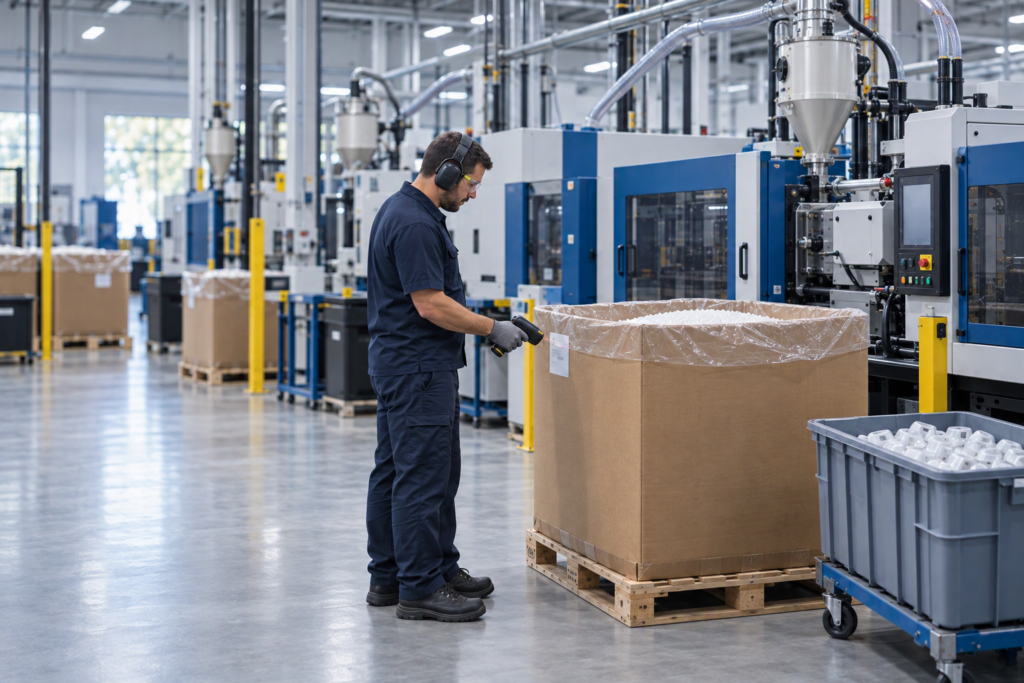
Warehouse-level traceability and mobile data capture: The SN Warehouse Tracking and Lot Warehouse Tracking toggles enforce assignment during physical warehouse movements. Mobile shop-floor and warehouse execution solutions extend the platform to barcode scanners, tablets, and smartphones, so an operator can scan a Gaylord label at the press, bind a resin lot to a work order, and post output — capturing genealogy at the moment of consumption instead of reconstructing it from paper travelers hours or days later.
Reporting and Power BI: Business Central’s manufacturing Power BI app, generally available from version 27.0, provides production order overviews, current and historical utilization, work center load, finished production order breakdowns, consumption variance, capacity variance, scrap, and Prod Order routings — all fed by the same lot-tracked transactional data.
Item Tracing supports two trace methods:
Trace Method
What It Does
Usage → Origin
Traces an item from where it was used back to where it came from. A manufactured item sold to a customer shows the sales shipment line first, expanding to reveal the production order it came from.
Origin → Usage
Traces an item from where it entered inventory forward to where it was used. The finished production order appears first, expanding to reveal the sales shipments where the item was consumed.
For a plastics manufacturer investigating a customer complaint, this workflow answers the two critical recall questions in minutes — narrowing scope to the specific lots and customer shipments actually affected, rather than issuing a broad time-window recall.
Key Quality Management capabilities include:
Automatic inspections at purchase receipt, production output, assembly output, and warehouse movement.
Manual and scheduled inspections for reactive or periodic scenarios.
Templates with customizable measurements and pass/fail criteria.
Automatic lot blocking when inspection results indicate non-compliance.
Non-compliant item handling — automatic movement to quarantine bins, negative adjustments for disposal, transfer orders to different locations, and purchase returns to vendors.
Workflow integration for automated responses.
Full warehouse handling support in both directed and non-directed put-away environments.
For a plastics manufacturer, this means a failed melt-flow-index test at receiving can automatically block the resin lot from being consumed on the production floor — preventing bad material from ever being molded into finished parts. For executives, Power BI reporting closes the loop between shop-floor traceability and boardroom decision-making, converting granular lot data into utilization, yield, scrap, and quality trends.
Where Plastics Traceability Requirements Go Beyond Standard Business Central
Business Central is the ERP foundation for lot traceability — not a complete QMS, LIMS, or formulation system. Plastics manufacturers typically extend or complement it where their requirements go further:
Recipes and batch production: Business Central is often extended with an industry solution such as COSMO Process Manufacturing for recipes, batch production, and lot management.
Shop-floor and warehouse data capture: Mobile shop-floor and warehouse execution solutions complement Business Central to capture lots on barcode scanners, tablets, and smartphones at the point of use.
Bulk storage and cavity-level attribution: Silo mixing models, “heels” assumptions, loader and manifold events, and cavity- or lane-level attribution require deliberate process design and data capture beyond standard item tracking.
Quality systems: Native Quality Management handles inspections, lot blocking, and non-compliant items; it does not by itself replace a full QMS or LIMS for regulated programs.
Recycled-content chain of custody: Track-and-trace systems for recycled plastics use QR codes, geotagging, photo verification, and chain-of-custody records to prove recycled-content claims.
Measurable Executive-Level Outcomes
Manufacturing executives typically evaluate traceability investment against six outcomes:
Reduced risk exposure: Focused holds and lot-level recalls replace plant-wide panics — the difference between defending unaffected lots with confidence and issuing broad time-window recalls that unnecessarily suppress revenue in the recalled category by 10–20% for 24 months.
Improved operational visibility: Real-time production, inventory, and quality data replaces spreadsheets and paper travelers — the foundational shift that most plastics processors identify as an operational efficiency lever they fully control.
Stronger customer trust and retention: OEMs increasingly expect Device History Record–level detail (which resin lots, through which silo and loader route, using which tool) — the ability to provide it becomes a commercial requirement.
Better decision-making: Correlating defects to specific materials, machines, operators, and process parameters accelerates root cause and drives continuous improvement.
Compliance confidence: Defensible documentation trails for FDA QMSR, IATF 16949, ISO 13485, PPWR, IMDS, and food-contact regulations — auditable from a single system rather than reconstructed under audit pressure.
Recall economics: Cutting the defect-to-recall-initiation window from 28–45 days to under 10 days materially reduces total recall cost, insurance gaps, and brand-trust erosion.
A Representative Industry Scenario
Consider the pattern that recurs across mid-market plastics manufacturers: a company supplies plastic components to customers in regulated industries — medical, food-contact, or automotive — where lot traceability is a contractual and compliance requirement. Lot numbers are being recorded, but the information is fragmented across production paper, quality spreadsheets, ERP receipts, and shift-lead notebooks. When a customer calls with a defect concern, the quality manager spends the next two days manually reconciling records to identify which resin lot was consumed on which press during which shift — and often ends with “we think” answers that cannot narrow recall scope.
As leadership evaluates modernization, the pattern of response looks remarkably consistent industry-wide:
Consolidate onto a single connected platform. Replace disconnected systems with Business Central, often extended with an industry solution such as COSMO Process Manufacturing for recipes, batch production, and lot management.
Enforce lot tracking systemically. Configure Item Tracking Codes so lot capture cannot be skipped at receiving, production, or shipping.
Bind material lots to work orders at consumption. Use shop-floor scanners and the Production Journal to capture genealogy at the moment resin is issued to a machine.
Enable Item Tracing for recall response. Train quality teams to run Usage → Origin and Origin → Usage traces on demand.
Deploy Quality Management for inspection-driven lot blocking. Automatically quarantine non-compliant lots before they reach production.
Feed executive dashboards through Power BI. Turn lot-tracked transactional data into utilization, scrap, quality, and yield insights.
FRAGMENTED LOT RECORDS
CONNECTED LOT GENEALOGY
→
Lot data scattered across production paper, quality spreadsheets, ERP receipts, and shift-lead notebooks
→
Lot capture enforced systemically at receiving, production, and shipping on a single connected platform
→
Customer complaint responses take days of manual reconciliation
→
Customer complaint responses move from days to minutes
→
Recall scope covers everything produced that week
→
Recall scope narrows to the 47 pallets that consumed lot A-1847
→
Regulatory audits are stressful reconstructions
→
Regulatory audits become routine reporting from a single system of record
The outcome is not a “traceability project” — it is a shift in how the operation runs day-to-day. Quality investigations become data-driven rather than tribal.
Future Outlook: Traceability as a Competitive Differentiator
The trajectory for plastics executives is clear. Regulatory pressure will continue to intensify, customer expectations will continue to sharpen, and the economics of a slow recall response will continue to compound. What was once a defensive investment — traceability as a cost of compliance — is becoming an offensive one: a competitive moat that shortens sales cycles with regulated OEMs, protects brand equity through faster recall response, and unlocks premium markets that require verifiable material provenance.
Plastics manufacturers that treat end-to-end lot traceability as operational infrastructure — not a compliance overlay — position themselves to gain first-mover advantage as regulations phase in and OEM audit expectations tighten. Those that stay in “wait-and-see” mode risk facing a Class I event with a fragmented lot record — the scenario in which recall costs compound rather than compress.
Questions Plastics Executives Should Ask
Forward Trace
Given a resin lot, which parts, batches, customers, and markets did it end up in?
Backward Trace
Given a defective part or complaint, which resin lot(s) and suppliers contributed to it?
Bulk Storage
Do we know which lots are loaded into which silos and day bins, or is each silo a generic vessel with no lot history?
Lot Capture
Can lot capture be skipped at receiving, production, or shipping?
Readiness
If we pick a finished-goods lot shipped last quarter, can our team identify every input resin lot, colorant lot, additive lot, machine, mold, cavity, operator, shift, and quality result behind it?
“How ready are we?” is best answered by attempting a real trace. If the answer takes more than an hour, the operational, financial, and regulatory case for investing in end-to-end lot traceability likely writes itself.
The Executive Takeaway
End-to-end lot traceability is no longer a quality-department capability. It is a boardroom capability that determines how quickly your operation can respond to a defect, how narrowly you can contain a recall, and how confidently you can bid on regulated OEM contracts.
Across the plastics industry, leaders are consolidating fragmented lot data onto integrated ERP platforms, enforcing lot capture systemically at every material touchpoint, and using the resulting genealogy to drive faster investigations, tighter recall response, and stronger customer trust.
Microsoft Dynamics 365 Business Central provides the operational backbone that makes this shift practical for mid-market plastics manufacturers. Its native serial, lot, and package tracking; production consumption and output posting; forward and backward Item Tracing; native Quality Management with lot-blocking and non-compliant handling; warehouse-level traceability; and Power BI reporting together deliver the end-to-end genealogy that industry leaders are converging on — without the integration complexity and cost of standing up multiple point systems.
How plastics manufacturers are connecting production, people, materials, quality, and inventory with Microsoft Dynamics 365 Business Central and mobile data collection.
How plastics manufacturers are turning recovered material into a controlled inventory asset with Microsoft Dynamics 365 Business Central and COSMO Process Manufacturing.
Ready to improve visibility,
reduce operational complexity and build a stronger foundation for growth?
Whether you’re evaluating a new ERP platform, planning an upgrade, or improving your manufacturing operations, a Manufacturing Strategy Session can help identify opportunities to improve visibility, operational performance, and determine the right path forward.