



Business Central

Case Studies
Plastics Manufacturing
Achieving End-to-End Lot Traceability in Plastics Manufacturing
An Industry Case Study for Manufacturing Executives — Powered by Microsoft Dynamics 365 Business Central
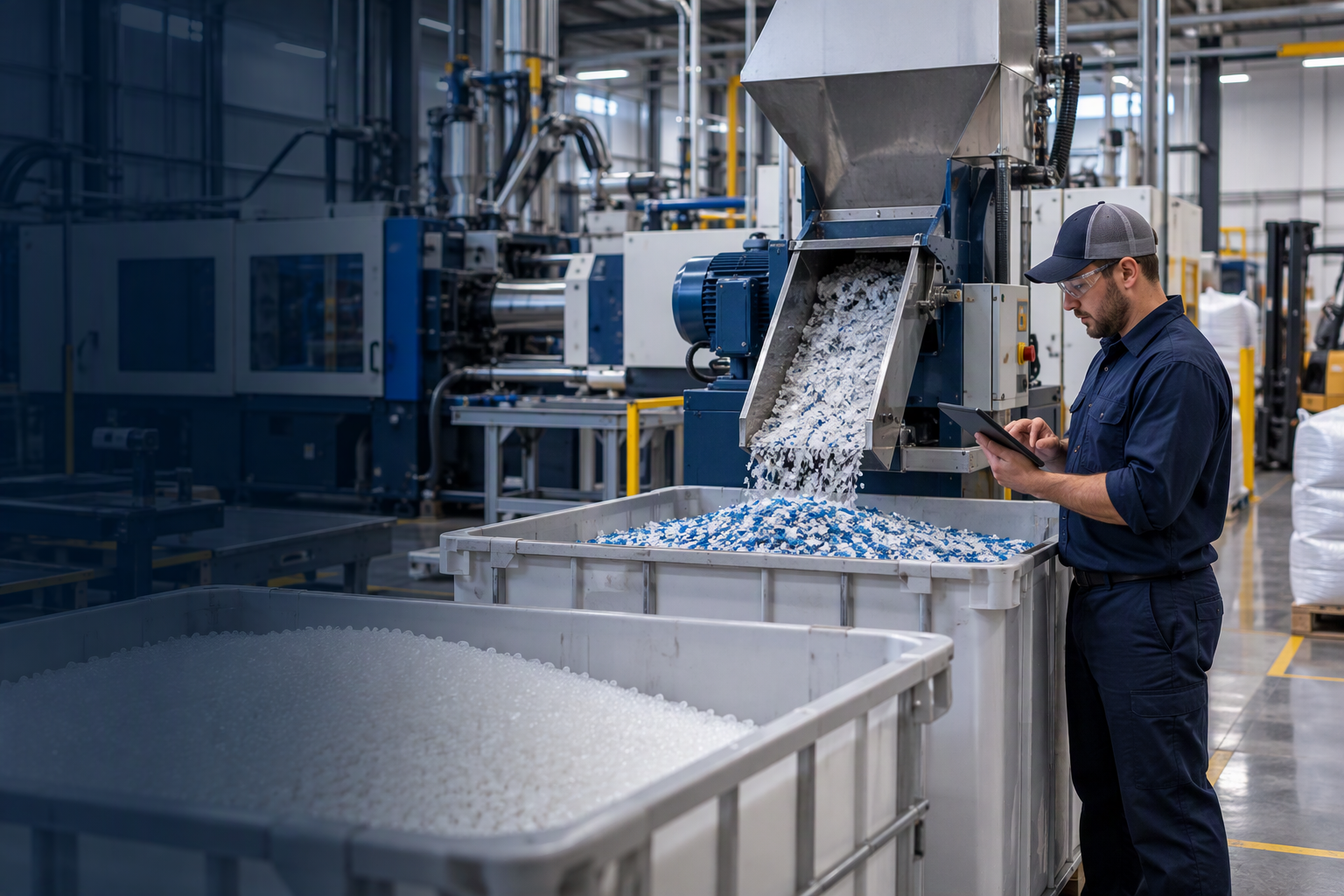
How plastics manufacturers are turning recovered material into a controlled inventory asset with Microsoft Dynamics 365 Business Central and COSMO Process Manufacturing.
This is a composite industry case study covering injection molding, extrusion, blow molding, thermoforming, compounding, and related plastics operations. It describes industry practices and achievable operating outcomes, not the results of one named manufacturer.
Regrind sits in an uncomfortable place on the plastics manufacturer’s balance sheet. Physically, it is usable polymer recovered from runners, sprues, trim, startup scrap, purgings, and rejected production. Operationally, it may replace virgin resin, reduce disposal, and support circular-material goals. Financially, however, it is frequently treated as though it were free, even though the original resin, machine time, labor, handling, grinding, storage, inspection, and quality risk are not free.
That disconnect creates a management problem. If recovered material is returned to a hopper without a controlled inventory transaction, the plant may reduce virgin consumption while simultaneously losing visibility into material yield, scrap generation, inventory value, production variance, product cost, and gross margin. Research on recycled polymers also shows that material origin, composition, contamination, degradation, and processing history influence suitability for reuse, making regrind a quality-controlled material, not merely an accounting adjustment.
The industry response is to treat regrind as a controlled secondary raw material with its own identity, quantity, quality status, permitted applications, and financial treatment. Microsoft Dynamics 365 Business Central provides the transactional and financial foundation. COSMO Process Manufacturing adds plastics-relevant capabilities for reclaimed items, regranulation, recipes, allowed incorporation, by-production, and proportional cost allocation.
When recovered material goes back into the hopper, can you still see your true yield, inventory value, production variance, and product margin?
Across plastics processing, manufacturing scrap can often be physically recovered faster than it can be financially understood. Inline granulators may return clean trim immediately, while centralized grinding operations may collect material from several machines, shifts, colors, or product families. The resulting flakes or pellets can differ in particle size, moisture, contamination exposure, additives, and thermal history.
The executive risk is not regrind itself. It is uncontrolled regrind:
UL Solutions distinguishes in-house molding regrind from post-industrial recycled material and ties reuse to material identity and testing context. Its UL 746D discussion allows up to 25% regrind when it comes from and is combined with the same virgin grade, but this is a standards-specific scenario, not a universal blend recommendation. Permitted content must follow resin behavior, product specification, customer requirements, certification, and the end-use risk profile.
Plastics manufacturers generally have several ways to reflect recovered material. Each can be valid in the right context, but each answers a different management question.
| Treatment model | What it emphasizes | Benefit | Limitation |
|---|---|---|---|
| Scrap-only reporting | Records the loss against the original run | Simple yield and variance reporting | Does not establish reusable inventory; later consumption can become invisible |
| Reduced or net consumption | Records only net virgin resin used | May approximate material purchasing needs | Conceals gross material input, scrap generation, recovery, and actual blend behavior |
| Separate regrind inventory item | Produces regrind into inventory and consumes it later | Preserves quantity, availability, usage, and valuation | Requires disciplined item, location, lot, and posting design |
| Reclaimed or by-product output | Treats recovered material as an additional production output | Connects recovery to the originating production process | Requires a defensible rule for assigning costs between primary and recovered outputs |
| Immediate closed-loop return | Sends material directly back to the same process | Reduces handling and storage | Transactions must avoid overstating output and consumption while retaining traceability |
The crucial decision is not simply whether regrind should carry a value. It is what that value represents. Management may allocate part of the original resin and conversion cost to the recovered output, assign only incremental grinding and handling costs, use an established standard cost, or apply another supportable policy. Business Central supports FIFO, Average, Specific, Standard, and LIFO costing methods, each affecting cost flow differently, so the policy should be designed with the controller and external accounting advisers before transactions begin.
A zero-cost regrind item can preserve quantity visibility, but it may overstate the apparent savings when regrind is consumed. Allocating excessive cost to regrind can understate the profitability of the original finished product. The objective is not to maximize the value of regrind. It is to adopt a repeatable policy that makes production economics understandable and reconcilable.
Manufacturers with stronger control separate the regrind lifecycle into distinct, auditable stages:
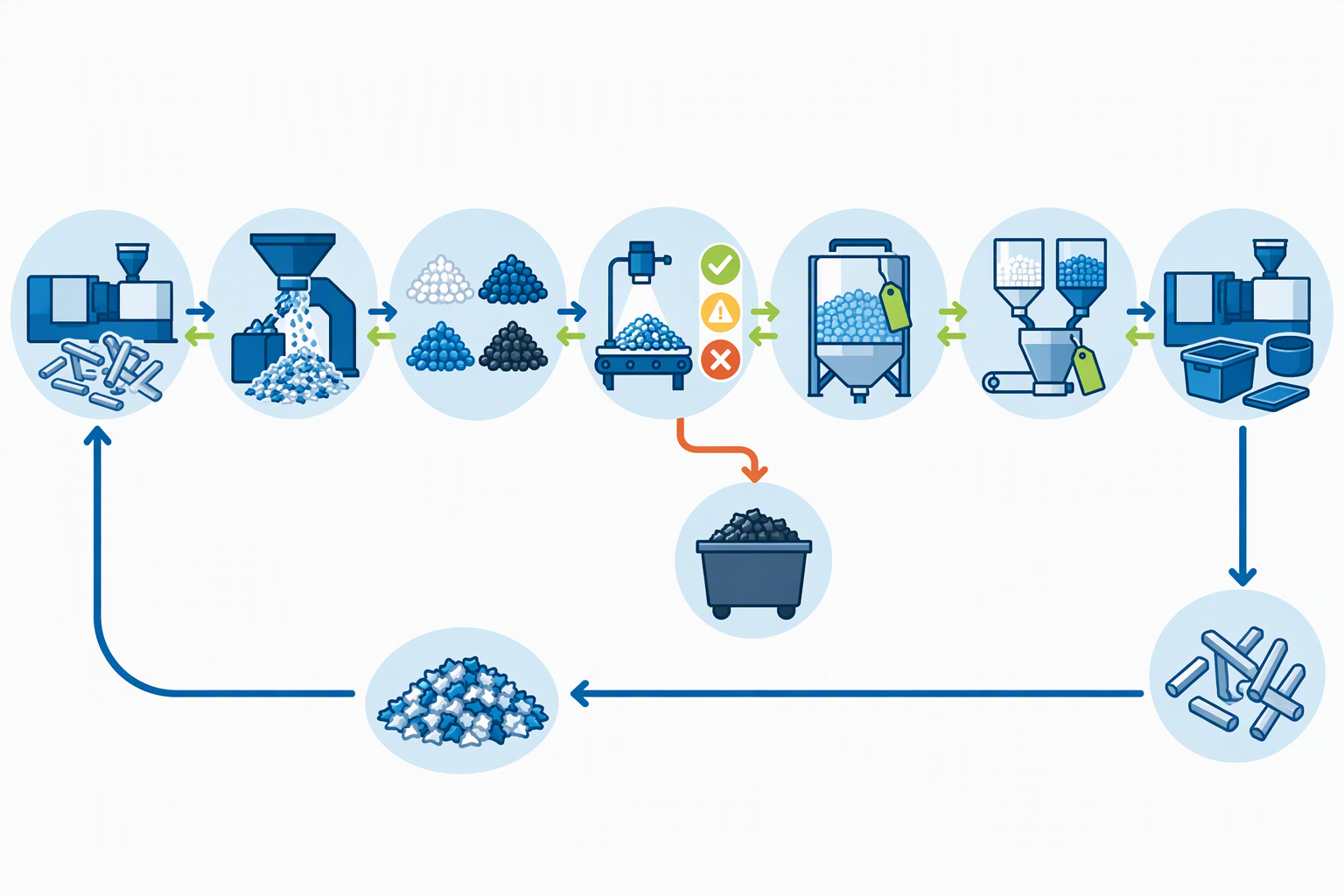
Business Central’s Production Journal can record consumption, output, scrap, and operation time, while finished production order costing brings together consumed material, capacity, subcontracting, and overhead. Cost adjustment then reconciles the production order with WIP and inventory and calculates standard-cost variances where applicable.
Business Central production orders coordinate the materials required, operations performed, quantities produced, scrap recorded, and time consumed. Production BOMs define components; routings define operations; and work or machine centers provide capacity and cost structures. Resin, colorants, additives, packaging, labor, machine burden, and overhead can all contribute to the same production-cost record.
The important design principle is to preserve gross flows. Production should report what entered the process, what became saleable output, what became recoverable material, and what was disposed. If only net resin consumption is reported, the organization cannot distinguish process improvement from greater regrind use.
Business Central records inventory quantity through item ledger entries and inventory value through value entries. Costing methods determine how value moves out of inventory, while cost adjustment forwards changed inbound cost to related outbound transactions and updates COGS. Finished production orders must be moved to Finished status before final production costs can be fully adjusted and reconciled.
This matters when regrind produced in one period is consumed later. A controlled item-based model allows finance to distinguish:
Business Central can assign lot, serial, and package numbers to inbound and outbound transactions, with posted tracking information connected to item ledger entries. Item Tracing can follow tracked material from origin to usage or from usage back to origin, including receipts, production, transfers, consumption, returns, and customer shipments.
For regrind, lot design can connect the reclaimed material to its source production run and later consumption. The level of separation should reflect risk: a general-purpose industrial stream might be controlled by resin family and color, while medical, food-contact, electrical, automotive, flame-retardant, reinforced, or customer-restricted material may require narrower segregation and more stringent approval.
Business Central Quality Management can create inspections at purchase receipt, production output, assembly output, and warehouse movements. It supports inspection templates, measurements, pass/fail criteria, lot blocking, workflow responses, quarantine movements, disposal adjustments, transfers, and vendor returns.
In a regrind environment, these capabilities can support checks appropriate to the material and application, such as contamination status, moisture, color, particle consistency, or melt-flow results. The ERP records the disposition and prevents blocked material from being treated as available inventory; the laboratory or quality procedure determines which tests and acceptance criteria apply.
Standard Business Central supplies the manufacturing, inventory, financial, and tracking foundation. COSMO Process Manufacturing becomes especially relevant where a plastics operation needs to model recovered material as an expected additional output or control how it re-enters formulas.
In the representative plastics operation, production teams recover substantial material, but finance cannot reliably explain its impact. The plant reports lower virgin consumption, yet leadership cannot determine whether the change came from improved yield, more regrind use, inventory timing, inaccurate reporting, or a shift in product mix.
|
UNCONTROLLED REGRIND
|
CONTROLLED MATERIAL STREAM
|
|---|---|
|
Some regrind returns inline, some goes to a central grinder, and some sits in floor containers awaiting a decision.
|
Intentional regrind streams have item numbers, defined locations, and quality statuses.
|
|
Blend percentages live in setup sheets or operator knowledge.
|
Approved material is consumed through controlled recipes or BOMs, with actual quantities posted.
|
|
Regrind quantities are estimated from virgin purchases.
|
Recovered output is recorded from production at the time of recovery and reuse.
|
|
Quality can't always connect a recovered lot to its source run and later finished product.
|
Lot tracking follows product risk, and quality results decide whether material is released, downgraded, sold, or disposed.
|
Business Central becomes the system of record; COSMO handles regranulation, reclaimed outputs, recipe incorporation, or cost allocation where those requirements apply. The result is not simply “more recycling.” It is a clearer economic model. Executives can compare gross resin input with good output, separate recoverable from unrecoverable scrap, see virgin and regrind consumption independently, identify excess reclaimed inventory, and connect production variances to product and customer profitability.
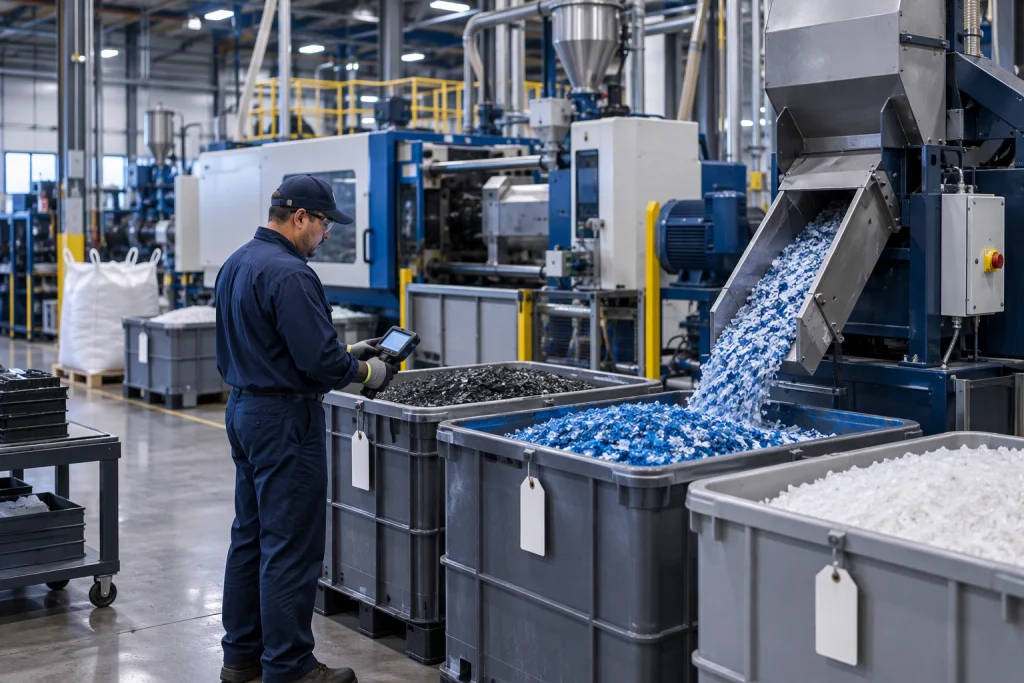
These outcomes should be treated as measurement objectives, not guaranteed software results:
| Executive outcome | Recommended measure |
|---|---|
| Material utilization | Good output ÷ gross material input |
| Regrind recovery | Approved recovered quantity ÷ recoverable scrap generated |
| Regrind utilization | Regrind consumed ÷ approved regrind available |
| Virgin displacement | Regrind consumed alongside change in virgin consumption |
| Inventory control | System quantity versus physical regrind quantity |
| Quality stability | Holds, rejects, downgrades, and complaints associated with regrind |
| Cost visibility | Virgin, recovered-material, grinding, disposal, and variance costs |
| Profitability | Margin by item, customer, product family, and production run |
| Traceability | Ability to connect source scrap, reclaimed lot, consuming order, and shipment |
| Working capital | Quantity, age, and value of approved and blocked regrind inventory |
The plastics industry is moving beyond the idea that regrind is merely waste avoided. It is becoming a controlled material stream that must satisfy the same executive disciplines as virgin resin: identity, quantity, quality, availability, value, permitted use, genealogy, and financial reconciliation.
Microsoft Dynamics 365 Business Central provides the connected operational and financial backbone for that discipline. COSMO Process Manufacturing strengthens the fit where plastics manufacturers require regranulation, reclaimed items, controlled formulas, allowed incorporation, additional outputs, proportional cost allocation, and specialized production analysis.
Together, they allow regrind to contribute to material efficiency without disappearing from the inventory record, production cost, or profitability story.

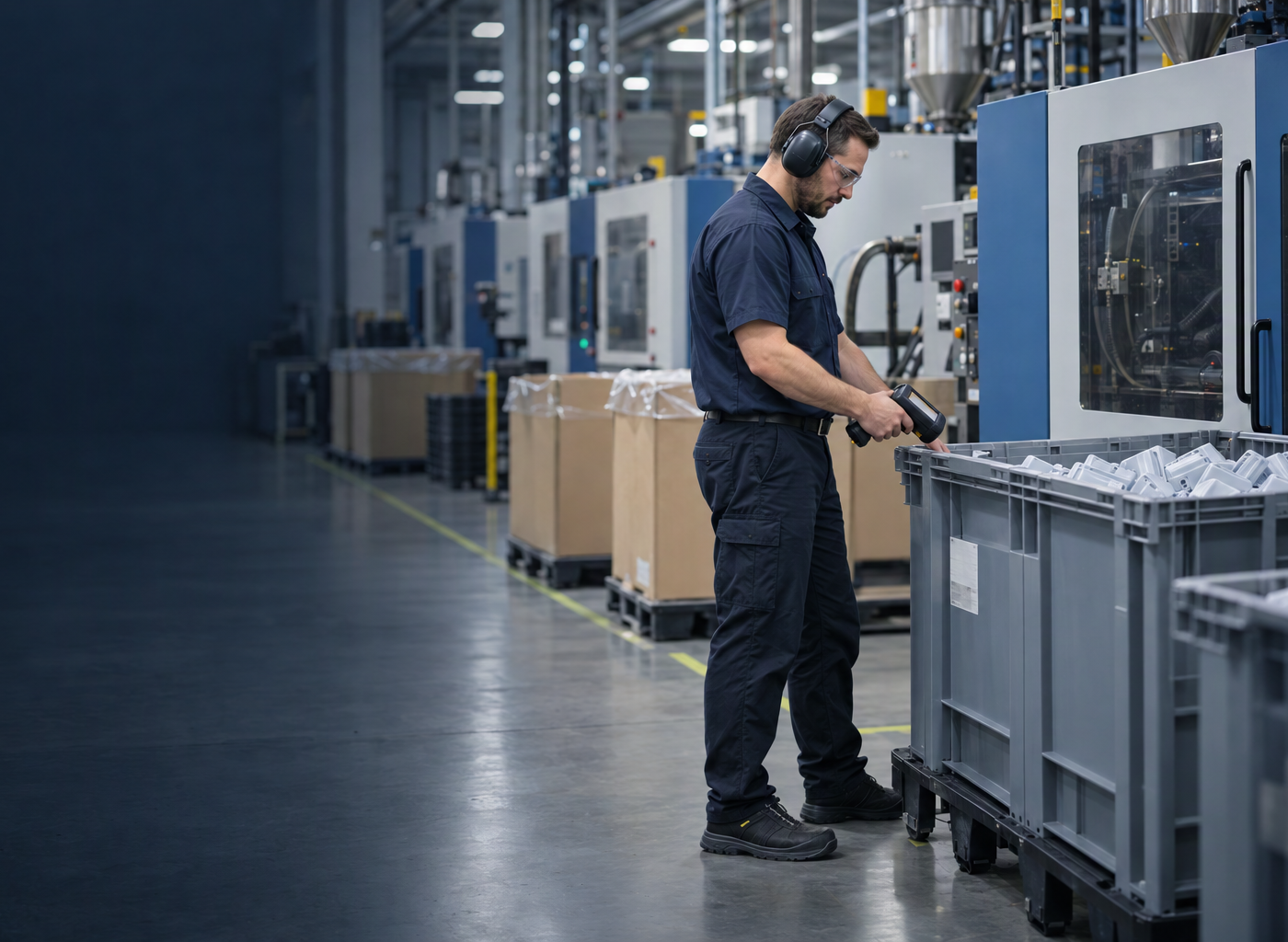



Whether you’re evaluating a new ERP platform, planning an upgrade, or improving your manufacturing operations, a Manufacturing Strategy Session can help identify opportunities to improve visibility, operational performance, and determine the right path forward.
