This is an evidence-based, composite industry case study. It reflects practices used across specialty alloy producers, foundries, service centers, processors, fabricators, and component manufacturers, not the results of one named company. Regulatory obligations vary by product, customer, contract, jurisdiction, and end market; manufacturers should validate the requirements that apply to each program.
For specialty metals executives, heat number traceability is no longer simply a quality-record requirement. It determines whether the organization can prove material conformity, isolate a suspect heat, protect unaffected inventory, respond confidently to customer inquiries, and continue serving aerospace, defense, energy, transportation, pressure-equipment, and other specification-driven markets. ASTM E3315 specifically addresses metallic-material certifications, including traceability, the distinction between heat and lot numbers, certificates of compliance, and the information expected on material certifications. ISO 9001 likewise connects disciplined quality processes with customer confidence, complaint resolution, process improvement, and ongoing audit activity.
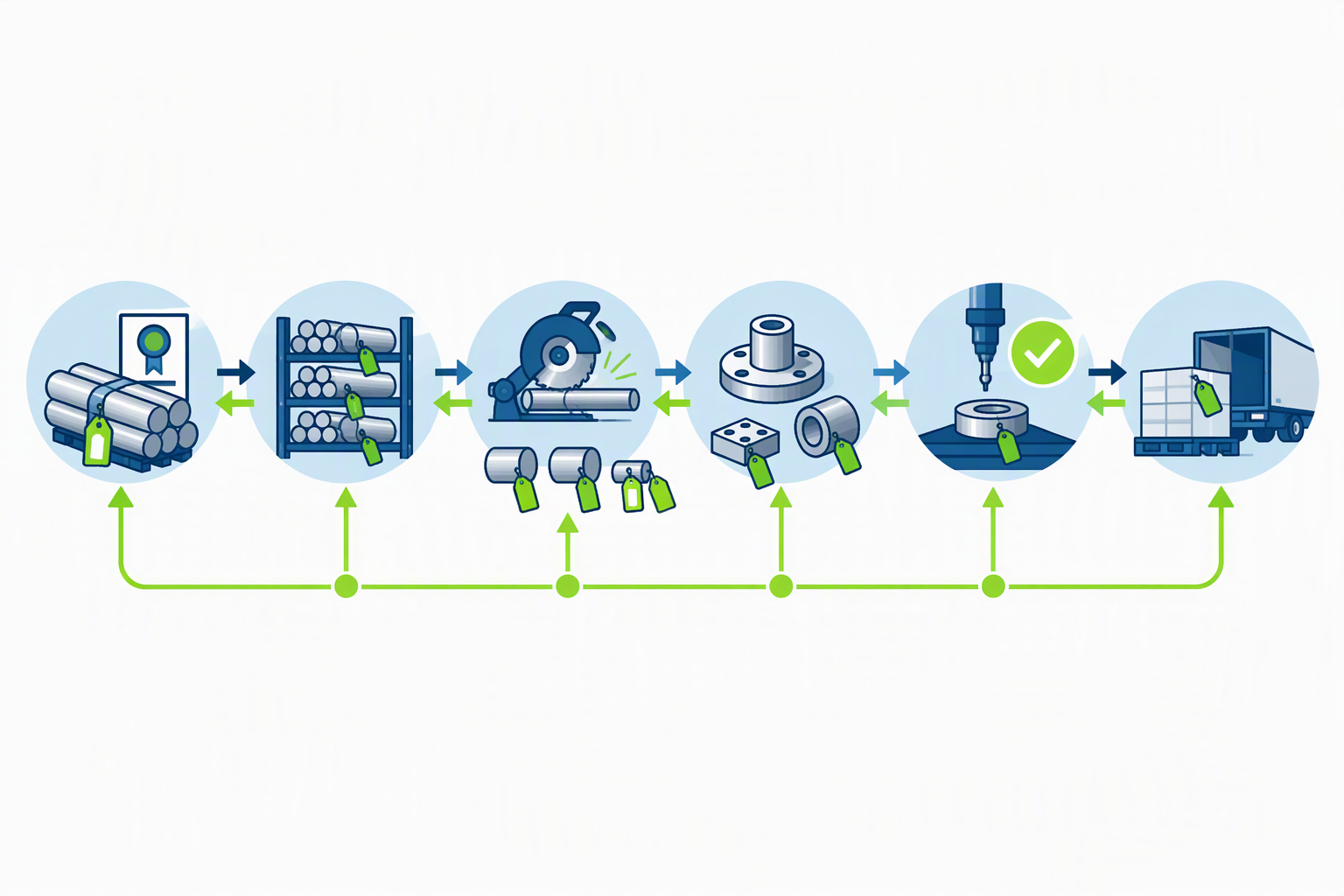
A defensible system must do more than retain a PDF mill test report. It must maintain an unbroken relationship among the physical material, supplier heat, material specification, MTR, internal inventory identity, production order, processing history, quality disposition, finished lot or serial number, and customer shipment.
Microsoft Dynamics 365 Business Central provides the ERP foundation for this operating model. Its item-tracking capabilities support serial, lot, and package numbers on inbound and outbound transactions; tracking entries are carried into item ledger entries; and configured lot-specific tracking requires the inbound identity to follow the material when it leaves inventory. Business Central can trace tracked inventory backward and forward through receipt, production, transfers, consumption, sale, and return.
The executive value is not “more traceability paperwork.” It is faster containment, more reliable inventory, stronger compliance evidence, fewer manual reconciliations, and greater confidence that the material being manufactured and shipped is the material that was specified.
Could you trace a suspect heat today?
If a mill questioned a heat tomorrow, could you identify every remnant, work-in-process item, finished component, and customer shipment that contains it?
The Business Situation: High-Value Materials, High-Cost Uncertainty
Specialty metals manufacturers operate across nickel, cobalt, titanium, zirconium, stainless, tool-steel, copper, aluminum, and engineered-alloy supply chains. Material may change form repeatedly, from ingot, billet, slab, coil, plate, tube, bar, wire, forging, or casting into cut blanks, remnants, work in process, heat-treated material, coated material, and finished components. Each transformation creates another opportunity for the heat identity to be lost, transposed, or separated from its supporting certification.
The underlying control is straightforward: a heat number identifies a melt and connects the physical material to the mill test certificate documenting its chemistry and mechanical properties. Maintaining that control becomes difficult when material is cut or split, when remnants return to stock, when multiple heats share a rack, or when outside processors return material under a different handling identifier.
The North American compliance landscape intensifies the need:
General quality systems: ISO 9001 is a globally recognized QMS standard used to demonstrate controlled processes, customer focus, performance evaluation, and continual improvement.
Metal certification: ASTM E3315 defines relevant certification terminology and information requirements for metallic materials.
Defense: DFARS 252.225-7009 defines covered specialty metals, imposes melt-or-production origin restrictions for applicable DoD items, and requires the clause to flow into relevant subcontracts. Heat-level provenance is a practical foundation for supporting that evidence, although heat tracking alone does not establish DFARS compliance.
Aerospace: FAA AC 20-154A recommends receiving-inspection systems that establish sufficient traceability for aeronautical parts and materials, while making clear that the circular is guidance rather than a standalone regulation.
Canadian aviation: Transport Canada defines traceability as the ability to trace a part’s history or origin to the organization that certified it and expects acceptable documentation supporting effectivity, condition, traceability, and eligibility for installation.
Energy and pressure equipment: API Specification Q1’s current scope includes manufacturing, welding, heat treating, coating, inspection, testing, distribution, and logistics. ASME’s Boiler and Pressure Vessel Code addresses materials, fabrication, inspection, testing, and certification and is widely embedded in U.S. and Canadian pressure-equipment practice.
No single heat-traceability rule applies uniformly to every specialty-metals shipment. The required granularity, records, markings, retention period, and certificate package should be driven by the customer contract, material specification, product code, quality plan, and end-use risk.
What End-to-End Heat Number Traceability Looks Like
1. Receiving: Establish the Identity Before Material Enters Stock
Receiving verifies that the heat marked on the plate, bar, tube, coil, forging, or bundle matches the certificate and purchase specification. The transaction should capture the supplier heat, mill, material grade, specification and revision, dimensions, quantity or weight, country of melt or production where required, MTR reference, and inspection status. Material with a mismatch, missing certificate, or unresolved specification issue remains on hold rather than becoming available inventory.
In Business Central, the supplier heat can be represented by the Lot No., or an internal lot can cross-reference the external heat where business rules require a separate identity. Item Tracking Codes determine where lot information is required, while Lot Specific Tracking requires a particular lot to be identified as material moves out of inventory.
2. Inventory and Warehousing: Preserve Identity Through Every Move
Inventory is segregated by heat, specification, form, dimension, ownership, and quality status. Rack, bin, coil, bundle, spool, container, or handling-unit labels carry scannable identifiers. Different heats should not become operationally indistinguishable simply because they share the same item number or material grade.
Business Central supports tracked inventory in warehouse activities, transfer orders, directed put-away and pick environments, physical inventory journals, and package structures. Its availability views also expose when a selected lot is unavailable or already allocated elsewhere, helping prevent double allocation.
3. Cutting, Slitting, and Remnants: Inherit the Parent Heat
Conversion is one of the most common breakpoints. When a coil, plate, bar, or tube is split, every output piece, and every usable remnant, must inherit the correct heat identity. The system should record parent material, output quantity or weight, scrap, remnant dimensions, storage location, and the production or cutting order responsible for the transformation.
This often requires metals-specific configuration or an extension beyond standard item tracking. Business Central provides lot reclassification and can split tracked quantities across journal lines, but dimensional inventory, catch weight, coil genealogy, cut optimization, remnant geometry, or multi-output conversion should be explicitly designed and tested rather than assumed to be standard functionality.
4. Manufacturing and Special Processing: Build the Genealogy
At production, the actual input heat is consumed against the work order and a controlled output lot or serial number is created. The genealogy should preserve base-material heats, filler-metal lots where applicable, intermediate lots, production operations, heat-treatment batches, inspection results, and outside-processing certificates.
Business Central Premium uses production BOMs, routings, work and machine centers, and production orders to coordinate material, operations, output, capacity, and cost. The Production Journal records components consumed, output produced, scrap, and operation time; posting updates item, capacity, cost, and production-progress records together.
5. Quality and Quarantine: Make Status Operational
A material identity is only useful when quality status follows it. Leading practices distinguish received, inspection-pending, approved, conditionally accepted, nonconforming, rework, and rejected inventory. Users should not be able to consume or ship a failed heat merely because the physical stock is present.
Introduced in Business Central 2026 release wave 1, Microsoft’s Quality Management extension can generate inspections at purchase receipt, production or assembly output, and warehouse movement. It supports configurable inspection templates, pass/fail criteria, workflows, lot blocking, quarantine movements, disposal adjustments, transfers, and vendor returns. New environments receive the Microsoft-published extension automatically; existing environments can install it separately.
6. Shipping and Customer Documentation: Complete the Chain
Shipping selects approved inventory that satisfies the customer’s heat, origin, certification, segregation, and documentation requirements. The posted shipment should identify the exact heat and quantity delivered, not merely the item number. Depending on the contract, the certificate package may include the original MTR or certified copy, Certificate of Conformance, inspection report, heat-treatment or NDT records, PMI results, and a heat-to-part cross-reference.
Business Central carries selected lot information into outbound and warehouse transactions and item ledger entries. Package numbers can support pallet, bundle, or handling-unit identity, while Item Tracing can identify which customers received a particular tracked lot.
The Fragmented “Before” Environment
The representative specialty-metals manufacturer in this composite case study was not failing to record heat numbers. It was failing to maintain one governed chain. Typical symptoms included:
Supplier heat and MTR information entered in a receiving spreadsheet
Different internal identifiers used by inventory, production, and quality
Paper travelers carrying handwritten heat numbers
MTR PDFs stored by purchase order rather than indexed by heat and shipment
Cut pieces and remnants relabeled manually
Outside-processing records disconnected from the production order
Quality status maintained in a separate workbook
Shipping personnel searching shared folders for certificates
Recall or audit traces assembled by reconciling ERP entries, paper, email, and spreadsheets
These weaknesses are consistent with the failure modes identified in metals guidance: unmarked remnants, transposed heat numbers, certificates not matched at receiving, mixed storage, and incorrect certificate-to-heat relationships.
The operational consequence is uncertainty. If a mill later questions a heat, the business may know that it purchased the material but not precisely which remnants, WIP, finished components, subcontract shipments, or customer deliveries contain it. That uncertainty expands containment and consumes time across quality, operations, customer service, purchasing, and finance.
FRAGMENTED
CONNECTED GENEALOGY
→
Heat and MTR details typed into a receiving spreadsheet.
→
Heat identity captured as a tracked lot at receipt and verified against the certificate.
→
Handwritten heat numbers on paper travelers and manually relabeled remnants.
→
Heat identity scanned at the point of work and inherited by every cut piece and remnant.
→
Quality status kept in a separate workbook.
→
Quality status follows the lot, so failed heats can't be consumed or shipped.
→
Audit traces rebuilt from ERP entries, paper, email, and shared folders.
→
Backward and forward traces run directly from posted transactions.
The Modernized Solution Approach
Business Central as the Governed ERP Backbone
The solution establishes Business Central as the authority for:
Material identity: Item, variant, heat/lot, serial, package, specification, and applicable attributes.
Financial context: Inventory valuation, production cost, scrap, subcontracting, and variance.
Trace response: Backward tracing from finished product to source heat and forward tracing from source heat to inventory and customers.
Business Central’s Item Tracing supports Usage → Origin and Origin → Usage views, while Find Entries locates posted and open records for a serial or lot. Item Tracing displays applied transactions, which makes correct inventory application and posting discipline an important design consideration.
Extend Capture to the Point of Work
Heat genealogy is only as reliable as the transactions captured where material physically moves. Business Central’s mobile app can scan 1D and 2D barcodes into item-tracking, warehouse activity, item journal, physical inventory, and tracing pages.
For higher-volume plants, Naviona Shop Floor & Warehouse Mobile extends Business Central to barcode scanners, tablets, smartphones, and mobile computers. Its capabilities include receiving, put-away, picks, movements, transfers, counts, production output, consumption, scrap, downtime, and rule-based label printing, reducing dependence on delayed paper entry.
MES, machine systems, QMS/LIMS, document management, and external processor portals should remain connected where they hold specialized evidence. The governing principle is one genealogy, clear ownership: Business Central owns business-critical material transactions; edge systems capture detailed process, laboratory, machine, or document information and return the identifiers needed to complete the trace.
Turn Trace Data into Executive Control
Microsoft’s Power BI Manufacturing app includes utilization, work-center load, production-order status, consumption and capacity variance, production scrap, cost, routing, and WIP reporting, and Microsoft positions its leadership analytics for Chief Operating Officer and Chief Manufacturing Officer roles.
The standard manufacturing app is not, by itself, a metals heat-certification dashboard. Organizations should add role-specific measures such as unmatched MTRs, inventory on quality hold, missing heat scans, heat-to-shipment trace completion, certificate-package completeness, remnant accuracy, and exception aging.
Implementation Considerations
A successful program begins with process and data governance rather than scanner selection.
Workstream
Executive decision
Traceability policy
Define which products require heat-, lot-, or serial-level control and whether mixed heats are permitted.
Identifier design
Decide when the supplier heat is the Business Central lot and when an internal lot must cross-reference it.
Certificate architecture
Define how MTRs, CoCs, test results, and processor certificates are indexed, versioned, retained, and delivered.
Conversion model
Design how cutting, splitting, combining, rework, scrap, and remnants preserve genealogy.
Quality gates
Define inspection triggers, release authority, quarantine logic, overrides, and audit history.
Mobile execution
Place scan controls at receiving, issue, production, movement, count, packing, and shipping, not after the event.
Integration ownership
Assign the system of record for chemistry, lab results, machine data, certificates, and ERP transactions.
Validation
Run backward and forward mock traces across representative materials, sites, subcontractors, and customers.
The implementation should prioritize the highest-risk material flows first: safety-critical alloys, customer-mandated certification, defense-origin requirements, pressure-boundary products, aviation programs, and materials frequently split into remnants. Requirements must be tested against actual customer specifications and contracts; neither an ERP configuration nor possession of an MTR alone proves compliance.
Measurable Executive Outcomes
Published evidence supports the direction of these benefits, but no authoritative source establishes a universal specialty-metals percentage attributable solely to Business Central. The following should be treated as measurable operating outcomes, not guaranteed benchmarks.
COO outcome
Recommended KPI
Faster investigations
Median time to complete Usage → Origin and Origin → Usage traces
Narrower containment
Percentage of suspect inventory and shipments identified at exact heat/lot level
Better audit readiness
Time required to produce the complete heat-to-customer evidence package
Stronger inventory accuracy
Heat-level book-to-physical accuracy and unidentified-remnant count
Improved documentation
Percentage of shipments released with complete, correct certificate packages
Better quality control
Number and age of heats awaiting inspection, blocked, quarantined, or under deviation
Reduced manual effort
Hours spent retrieving MTRs, reconciling spreadsheets, and rekeying heat numbers
Higher customer confidence
Trace-documentation response time and heat-certification-related complaints
Stronger compliance posture
Percentage of applicable orders with verified specification, origin, and flow-down requirements
The most defensible business case is built by baselining these measures before implementation and repeating the same mock-trace scenarios after deployment. The expected improvement is a shift from reconstructed evidence to transaction-driven evidence: fewer searches, fewer ambiguous records, more targeted containment, and more repeatable audit response.
Conclusion: Traceability as Operational Infrastructure
Leading specialty metals manufacturers are moving beyond “certificates on file.” They are building a digital material genealogy that survives receipt, storage, cutting, remnant creation, production, heat treatment, outside processing, inspection, packaging, and shipment.
For COOs, the outcome is control: know what the material is, where it is, whether it is approved, what it became, and who received it.
Business Central provides the connected ERP foundation for that control through item tracking, item ledger entries, warehouse transactions, production orders, quality workflows, forward and backward tracing, and manufacturing analytics, while mobile, MES, QMS/LIMS, and document capabilities extend capture to the physical operation.
Test Your Heat Traceability Before a Customer or Auditor Does
Select one recently shipped finished lot. Trace it backward to every contributing material heat and certificate, then trace one incoming heat forward to all remaining inventory, WIP, finished goods, and customer shipments. Use the results to prioritize a Manufacturing Strategy Session or ERP Readiness Assessment.
Managing Remnants and Partial Material Consumption in Specialty Metals Manufacturing
How specialty metals manufacturers can improve material utilization, inventory visibility, and profitability with Microsoft Dynamics 365 Business Central.
How plastics manufacturers are connecting production, people, materials, quality, and inventory with Microsoft Dynamics 365 Business Central and mobile data collection.
Ready to improve visibility,
reduce operational complexity and build a stronger foundation for growth?
Whether you’re evaluating a new ERP platform, planning an upgrade, or improving your manufacturing operations, a Manufacturing Strategy Session can help identify opportunities to improve visibility, operational performance, and determine the right path forward.