Managing Make-to-Order Manufacturing Without Losing Visibility
How industrial manufacturers can connect customer demand, materials, production, capacity, delivery, and cost with Microsoft Dynamics 365 Business Central.
Make-to-order manufacturing creates a different operational challenge than producing standard products for inventory. The customer order doesn’t simply trigger a shipment from available stock. It can create a chain of activity involving purchasing, components, production orders, capacity, subcontracting, assembly, testing, and final delivery.
For many industrial manufacturers, the underlying information exists. The challenge is keeping it connected. Sales may know what the customer requested. Purchasing knows which materials are coming. Production knows what’s being built. Planning knows where capacity is constrained. Finance knows what has been spent.
The objective of a modern make-to-order manufacturing system is to turn those separate views into one connected manufacturing story. For organizations using Microsoft Dynamics 365 Business Central, ERP can provide the foundation connecting sales demand to planning, purchasing, manufacturing, inventory, capacity, costing, shipment, and finance.
Can you see everything required to deliver each order?
Once we accept a customer order, can we see everything required to manufacture and deliver it profitably and on time?
The Industry Challenge: Every Order Creates Its Own Supply Chain
In a make-to-stock environment, production typically replenishes inventory in anticipation of demand. Make-to-order manufacturing changes the relationship. Demand starts with the customer, and that customer requirement can drive:
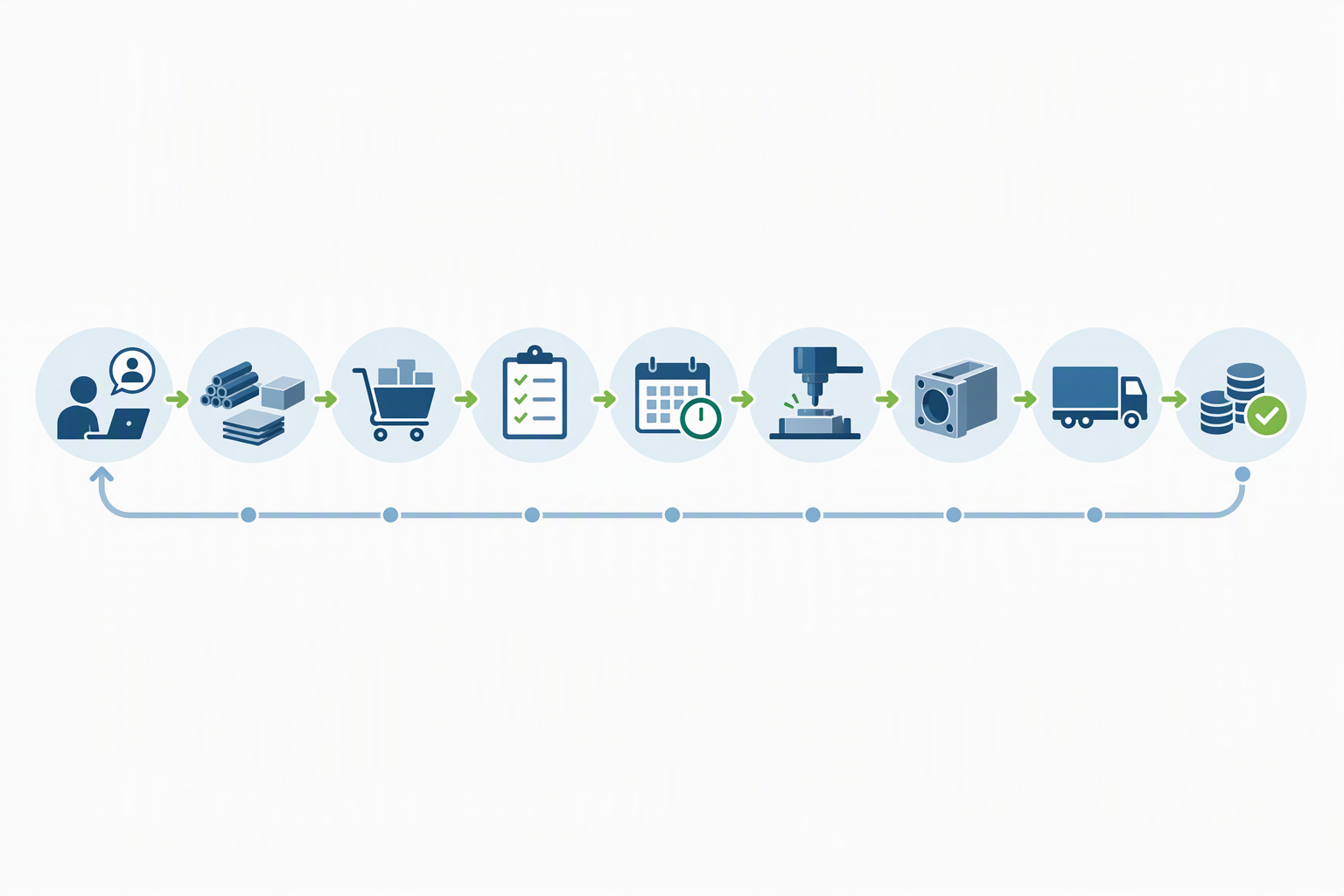
Customer Order → Material Requirements → Purchasing → Production → Capacity Requirements → Manufacturing Execution → Finished Product → Customer Shipment
When those processes are disconnected, visibility deteriorates quickly:
A salesperson may see the promised delivery date but not the material shortage threatening it.
A planner may see a production order but not immediately understand the commercial priority behind it.
Purchasing may expedite components without clearly seeing the production orders dependent on them.
Management may discover margin erosion only after the order has been completed.
The problem isn’t necessarily lack of activity.
It’s lack of connection between the activity and the customer demand that created it.
What Good Make-to-Order Visibility Looks Like
Make-to-order manufacturers are increasingly focusing on maintaining the relationship between demand and supply throughout the order lifecycle. From an executive perspective, that means being able to answer:
What has the customer ordered?
What must we manufacture?
What materials are required?
What needs to be purchased?
Do we have sufficient production capacity?
What is currently constraining delivery?
Where is the order in production?
When can we realistically ship?
What has the order actually cost us?
These shouldn’t require separate spreadsheets maintained by different departments. The stronger operating model connects them through common ERP transactions.
Building Demand-to-Delivery Visibility
1. Start with Customer Demand
In make-to-order manufacturing, the sales order isn’t simply the final shipping document. It is the beginning of the manufacturing process. The order establishes important commercial information such as:
Customer
Product
Quantity
Requested delivery
Pricing
Customer-specific requirements
From there, the manufacturing organization needs to translate that demand into an executable supply plan. This is where ERP becomes strategically important.
Rather than sales demand existing separately from manufacturing, the organization needs a direct connection between what was sold and what must be produced to fulfill it.
2. Connect Demand to Production
Once demand is understood, production needs to know what must be made. Many organizations lose visibility at precisely this point. Sales manages customer orders, production manages production orders, and spreadsheets, meetings, emails, and employee knowledge connect the two. A stronger make-to-order model keeps the relationship visible so the organization understands what customer demand each production activity supports. This becomes increasingly important when manufacturing involves:
Multiple production levels
Subassemblies
Long lead-time components
Multiple operations
Bottleneck resources
Outside processing
The customer’s order may be simple. The production required to satisfy it often isn’t.
3. Connect Material Requirements to Purchasing
A production order cannot proceed simply because it has been scheduled. The materials need to be available. Make-to-order manufacturers therefore need visibility into questions such as:
Which required components are already available?
Which components need to be purchased?
Which have already been ordered?
When are they expected?
Which shortages threaten production?
Which customer demand depends on those materials?
With Business Central as the ERP foundation, customer demand, inventory, production requirements, purchasing, and planning can operate within the same environment. The executive opportunity isn’t simply producing purchase recommendations. It’s creating visibility into how material availability affects the company’s ability to deliver customer orders.
4. Connect Production to Capacity
Materials are only part of the equation. The organization also needs enough productive capacity to complete the work. That means understanding demands on:
Work centers
Machine centers
Skilled resources
Critical operations
Subcontracted processes
A production order that has all the required materials can still miss its delivery commitment if the required resource is overloaded. The business can’t answer “Can we build it?” by looking only at inventory. It must also ask, “When do we have the capacity to build it?”
5. Give the Shop Floor Customer Context
Once manufacturing begins, visibility shouldn’t disappear into the plant. Operators and production supervisors need clear information about:
Production orders
Routing operations
Required quantities
Material requirements
Production priorities
Output
Scrap
Production status
As shop-floor activity is reported, that information should flow back into the manufacturing system, creating a feedback loop: Customer Demand → Plan → Production → Shop Floor → Actual Results. For Business Central customers, streamlined shop-floor solutions can make production reporting easier for operators while Business Central remains the manufacturing system of record.
6. Manage Exceptions Instead of Chasing Every Order
As a make-to-order manufacturer grows, executives and planners shouldn’t need to personally monitor every transaction. The more scalable approach is to identify exceptions, for example:
Material shortage
Late purchase
Capacity constraint
Production delay
Excessive scrap
Unexpected production time
Changing customer requirements
The objective becomes: Show me the orders at risk and why. That is considerably more actionable than a longer list of open production orders, and it shifts ERP from transaction processing toward operational decision support.
7. Connect Delivery Commitments to Manufacturing Reality
Sales wants to respond quickly to the customer. Operations needs to understand whether the requested delivery date is realistic. A reliable commitment may depend on:
Material availability
Supplier lead times
Required production operations
Existing production workload
Capacity constraints
Outside processing
Better manufacturing visibility helps these teams operate from the same information. The objective isn’t simply to make production move faster. It’s to make customer commitments more informed.
8. Connect Actual Manufacturing to Profitability
A make-to-order product can be delivered on time and still underperform financially, so executive visibility shouldn’t stop with shipment. Relevant questions include:
How much material was consumed?
How much production time was required?
Was there scrap?
Were outside services required?
Did actual manufacturing differ materially from expectations?
Did the resulting economics support the expected margin?
The more actual production information an organization captures, the better it can evaluate whether its original manufacturing and pricing assumptions were realistic.
The Role of Microsoft Dynamics 365 Business Central
For make-to-order manufacturers, Business Central can provide the ERP foundation connecting several critical business processes.
Sales: Capture the customer demand that initiates the process.
Planning: Translate demand, inventory, and supply requirements into manufacturing and purchasing decisions.
Purchasing: Manage the materials and outside services required to support production.
Inventory: Maintain visibility into available materials and inventory transactions.
Manufacturing: Use production orders, bills of material, routings, work centers, and machine centers to support manufacturing activity.
Capacity: Represent production resources and the work placed against them.
Shop-Floor Reporting: Capture actual production activity and output through Business Central or a purpose-built shop-floor experience connected to ERP.
Costing: Connect material, capacity, and manufacturing activity with product cost.
Sales & Shipping: Complete the demand cycle when finished products are delivered.
Finance: Connect manufacturing and commercial activity with the financial results of the business.
The value isn’t any one feature. It’s the relationship between them.
Make-to-Order Versus Engineer-to-Order
Industrial manufacturers should also distinguish between make-to-order and more complex engineer-to-order scenarios. A make-to-order product can still have a relatively established manufacturing definition, even though production begins in response to customer demand. Engineer-to-order may introduce additional complexity around:
Engineering design
Customer-specific specifications
New items
BOM development
Drawing revisions
Engineering release
Project milestones
Change management
Those environments may require Business Central to work alongside engineering, product-lifecycle, document-management, or other specialized systems. The key architectural principle remains the same:
The commercial requirement, engineering definition, manufacturing supply, and financial result should remain connected.
From Order Management to Demand-to-Delivery Visibility
ORDER MANAGEMENT
DEMAND-TO-DELIVERY
→
What's open?
→
What's preventing us from delivering it profitably and on time?
Between those two lies the core make-to-order question: what’s required to deliver it? That progression is what executives should expect from an integrated manufacturing ERP environment.
Questions Industrial Manufacturing Executives Should Ask
Sales
Can we connect customer demand directly to the supply required to fulfill it?
Materials
Can planners see which material shortages place customer orders at risk?
Purchasing
Do buyers understand which manufacturing requirements depend on critical purchases?
Production
Can management connect production activity back to the demand driving it?
Capacity
Can we see when critical resources threaten delivery?
Shop Floor
Does actual production status make it back into the ERP consistently?
Delivery
Are customer commitments based on manufacturing reality or judgment and spreadsheets?
Cost
Can management compare manufacturing assumptions with actual production economics?
Management
Can we identify orders at risk without manually reviewing every open order?
If several of those answers are difficult, the organization may have order visibility and production visibility without true demand-to-delivery visibility.
The Executive Takeaway
Make-to-order manufacturing requires more than creating a production order after receiving a sales order. The real challenge is maintaining visibility across the entire chain:
For industrial manufacturers building their operations around Microsoft Dynamics 365 Business Central, ERP can provide the foundation connecting these activities and helping departments operate from a shared view of demand and supply. The strategic objective is straightforward:
Know what the customer needs, know what it takes to build it, know what’s threatening delivery, and know whether the order remains profitable.
That’s the difference between managing production orders and managing a make-to-order manufacturing business.
How plastics manufacturers are connecting production, people, materials, quality, and inventory with Microsoft Dynamics 365 Business Central and mobile data collection.
Ready to improve visibility,
reduce operational complexity and build a stronger foundation for growth?
Whether you’re evaluating a new ERP platform, planning an upgrade, or improving your manufacturing operations, a Manufacturing Strategy Session can help identify opportunities to improve visibility, operational performance, and determine the right path forward.