Manufacturers spend considerable effort establishing standards. A routing may indicate that an operation should require 30 minutes of setup and two hours of run time. Work and machine center rates are established. Production schedules are built around expected capacity. Product costs incorporate expected production activity.
Those standards are important. But standards answer: How long should production take? Manufacturing executives also need to answer: How long did it actually take?
When actual production time isn’t captured consistently, organizations can find themselves making decisions about capacity, costing, scheduling, and profitability using assumptions that may no longer represent what is happening on the floor.
For industrial manufacturers using Microsoft Dynamics 365 Business Central, the opportunity is to connect production reporting more closely with the manufacturing transactions already driving production orders, routings, capacity, output, and cost.
Do your manufacturing standards match reality?
Your routing may tell you how long production should take. Your shop floor can tell you how long it actually takes.
The Industry Challenge: Estimated Time Isn’t Actual Time
Industrial manufacturers typically establish expected production times for good reasons. They are needed to support:
Production planning
Capacity calculations
Scheduling
Expected manufacturing cost
Quoting and estimating
Resource planning
The problem occurs when estimates become the only view management has of production time.
ROUTING STANDARD
ACTUAL ON THE FLOOR
→
Setup time: 30 minutes
→
Actual setup: 45 minutes
→
Run time: 120 minutes
→
Actual run time: 165 minutes
The difference matters. If the organization repeatedly plans around two hours while production consistently requires nearly three, the issue can surface elsewhere as overloaded capacity, late orders, cost variance, overtime, or unexplained margin pressure.
Capturing actual time closes that information gap.
Moving from Standards to Actual Manufacturing Data
Leading manufacturers aren’t abandoning standards. They’re making standards measurable. The stronger operating model is:
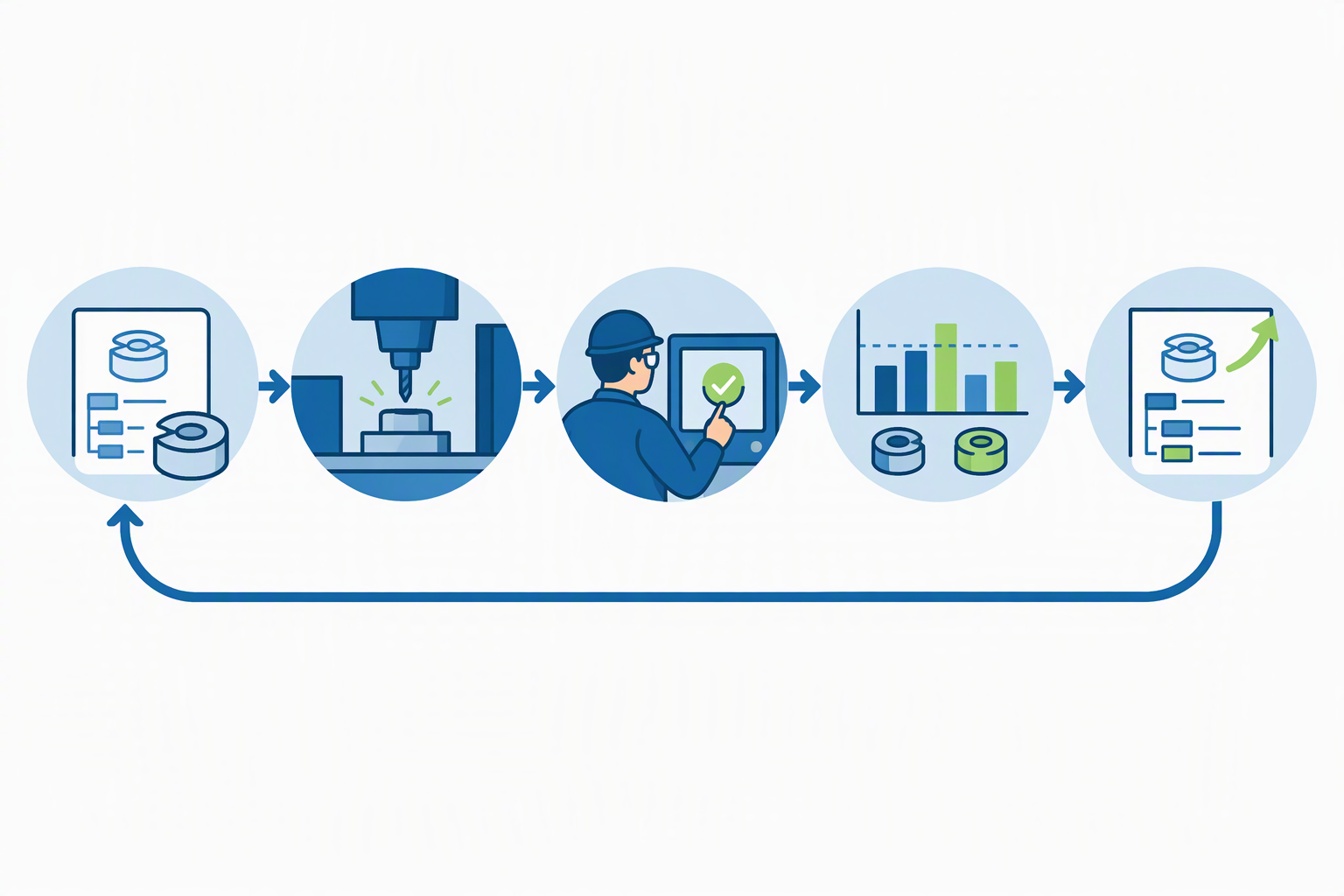
Expected Time → Execute Production → Capture Actual Time → Analyze Variance → Improve Standards
This creates a feedback loop. Instead of asking whether the routing is theoretically correct, management can determine whether the assumptions in that routing remain consistent with actual manufacturing performance.
That changes production data from a recordkeeping requirement into a continuous-improvement tool.
Building Planned-vs-Actual Visibility
1. Separate Setup Time from Run Time
Not all production time means the same thing. Consider two operations that both exceed their expected duration by 60 minutes:
Operation 1: Expected setup of 30 minutes, actual setup of 90 minutes
Operation 2: Expected run of 4 hours, actual run of 5 hours
Both have a one-hour variance, but potentially for very different operational reasons. Industrial manufacturers therefore benefit from distinguishing activities such as setup, run time, and other relevant capacity activity.
Where the variance occurs often matters more than the variance itself. For manufacturers with significant changeovers, setup performance may be a particularly important source of capacity improvement.
2. Capture Production Activity Where It Happens
One persistent manufacturing challenge is the distance between the ERP system and the operator. When production reporting depends on:
Paper travelers
Handwritten time sheets
Shared terminals
End-of-shift entry
Supervisor recollection
Manual spreadsheet updates
The data can become less useful operationally. Industry efforts increasingly focus on simplifying shop-floor reporting so that production information can be captured as part of the manufacturing process rather than reconstructed afterward.
A shop-floor experience tied to Business Central can be designed around the production information operators actually need while reducing unnecessary ERP complexity for the user. The principle is straightforward: Production data is most valuable when it is captured close to the activity that created it.
3. Connect Actual Time to Production Orders
Time data becomes more valuable when it has manufacturing context. Knowing that a machine ran for five hours doesn’t tell management much by itself. Executives need to connect that time to:
The production order
The manufactured item
The routing operation
The work or machine center
Production quantity
Output
Scrap or other production results
That allows management to move beyond asking “How many hours did we work?” and toward “What did those hours produce?” This distinction is essential when measuring manufacturing performance.
4. Compare Planned, Captured, and Posted Time
In a mature Business Central manufacturing environment, it helps to think about three views of production time:
Planned Time: What did the routing and production plan expect? This provides the baseline.
Captured Time: What activity did the shop floor actually report? This provides the operational view.
Posted Time: What production activity ultimately became part of the ERP’s posted manufacturing history? This provides the transactional view used downstream.
Comparing these three states helps reveal different types of issues. Planned 8 hours, captured 11 hours, posted 11 hours may point toward an inaccurate manufacturing standard.
But planned 8 hours, captured 11 hours, posted 8 hours suggests a different issue. The operation appears to have captured information that isn’t being reflected the same way in the final ERP transaction.
The point isn’t the particular numbers. It’s that planned, captured, and posted production information answer different management questions.
5. Improve Capacity Planning with Reality
Capacity planning depends on assumptions. If a work center is modeled around production standards that no longer reflect actual performance, the theoretical capacity plan can gradually diverge from operational reality. If a frequently produced operation is planned for 60 minutes but repeatedly requires materially longer, the organization may unintentionally promise more capacity than the operation can reliably deliver.
Actual time data allows production planners and manufacturing leaders to periodically evaluate whether:
Routing times remain realistic
Setup assumptions remain appropriate
Capacity expectations reflect actual operations
Specific work centers repeatedly experience variance
Scheduling assumptions need attention
Business Central can remain the planning and manufacturing backbone while actual production history helps management improve the assumptions feeding that model.
6. Strengthen Manufacturing Cost Visibility
Production time isn’t only a capacity issue. It’s also a costing issue. Manufacturing costs can depend on the resources consumed in producing the product. Suppose a product is consistently manufactured with an expected machine time of 3 hours but an actual machine time of 4.2 hours. If this pattern continues, management should understand whether:
The standard needs correction
The process needs improvement
Setup assumptions are inaccurate
Equipment performance is affecting production
Pricing assumptions need reconsideration
A production standard isn’t an immutable fact. It is an assumption that should be validated against actual performance.
7. Identify Bottlenecks with Better Data
Without reliable production reporting, management might know that orders are late without having sufficient evidence to understand where capacity is actually being consumed. Connecting time to operations creates opportunities to analyze:
Work center utilization
Machine center activity
Setup performance
Routing variance
Production order performance
Product-family patterns
This moves improvement discussions from “Where do we think we’re losing time?” toward “Where does our production history show that planned and actual performance consistently diverge?” That is a much stronger foundation for operational improvement.
8. Improve Manufacturing Standards Over Time
One of the most valuable outcomes of actual-time capture isn’t reporting. It’s better standards. A routing operation established years ago may have changed because of:
Different equipment
New tooling
Process improvements
Different product mix
Changed batch or lot sizes
New operators or methods
Automation
If nobody compares expected time with actual results, an outdated standard can continue influencing schedules and costs indefinitely. Actual time creates a feedback loop: Standard → Production → Actual Performance → Variance Analysis → Standard Review → Better Planning.
The objective isn’t to automatically rewrite routing standards based on every production result. Variability exists. Instead, manufacturers can use actual production history to identify persistent patterns worthy of investigation.
The Role of Microsoft Dynamics 365 Business Central
Business Central can serve as the manufacturing and transactional foundation connecting several parts of this process.
Production Orders: Provide the production context for what is being manufactured.
Routings: Define the sequence of manufacturing operations and expected production activity.
Work Centers and Machine Centers: Represent manufacturing capacity and associated production resources.
Capacity Planning: Use manufacturing definitions and available resources to support production planning.
Production Reporting: Connect manufacturing activity to the production transaction.
Output: Record production results associated with manufacturing orders and operations.
Costing: Connect production activity, materials, capacity, and other manufacturing costs to inventory and financial transactions.
The value comes from connecting these processes rather than treating production time as an isolated timekeeping exercise.
Where Shop-Floor Solutions Fit
There is an important distinction for manufacturing executives evaluating ERP. Business Central can be the manufacturing system of record without requiring machine operators to interact with the full ERP user experience. For many manufacturers, the stronger architecture is:
Business Central Manufacturing → Purpose-Built Shop Floor Experience → Operator Production Reporting → Business Central Manufacturing Transactions → Operational Analytics
A mobile or streamlined shop-floor solution can give operators a focused interface for the information they need to capture. Depending on the design, that might include:
Starting production activity
Ending production activity
Selecting an operation
Reporting quantities
Reporting scrap
Recording production observations
Reviewing assigned work
The precise workflow should reflect how the particular manufacturer runs production. The important principle is:
Make production reporting easy enough that accurate data capture becomes part of the work instead of additional administrative work.
What Executives Should Measure
Collecting production time doesn’t automatically create value. Industrial manufacturers should determine which comparisons drive decisions.
Planned vs. Actual Setup Time: Are changeovers consuming more capacity than expected?
Planned vs. Actual Run Time: Do routing assumptions reflect actual production?
Time by Work Center: Where is capacity actually being consumed?
Time by Machine Center: Are certain resources behaving differently from expectations?
Time per Unit: Is manufacturing efficiency changing as production volume or mix changes?
Variance by Product Family: Are particular products consistently harder to make than their standards indicate?
Production Output: What result did the reported production time create?
These measures give executives context rather than simply producing a timesheet report.
What Production Time Should Not Become
There is also a cultural consideration. If operators believe time capture exists solely to monitor individual employees, data quality and employee acceptance can suffer. The more valuable manufacturing conversation is around the process:
Are standards realistic?
Are machines creating constraints?
Are setups taking too long?
Do operators have the materials they need?
Are routing assumptions correct?
Where can the process improve?
For executives, this keeps production-time data focused on operational performance rather than employee surveillance.
From Estimated Time to Operational Intelligence
STANDARDS
ACTUALS
→
How long should production take?
→
How long did it actually take, and why was it different?
Standards remain essential, but actual production history gives management the evidence needed to determine whether those standards still reflect manufacturing reality.
Questions Industrial Manufacturing Executives Should Ask
Standards
When were our routing times last validated against actual production?
Shop Floor
How much production reporting still starts on paper?
Setup
Do we know how actual setup performance compares with the standard?
Capacity
Are capacity plans being built from assumptions that reflect current production reality?
Cost
Can we connect actual manufacturing activity with product cost?
Variance
Can we identify the products and operations that consistently run differently from plan?
ERP
Does actual production information make it back into Business Central consistently?
Improvement
Are we using production history to improve future manufacturing standards?
If several answers are difficult to provide, the manufacturer may be planning with estimates but managing without actuals.
The Executive Takeaway
Manufacturing standards will always be necessary. But standards become significantly more valuable when they can be compared with reality.
For industrial manufacturers using Microsoft Dynamics 365 Business Central, connecting routings, work centers, machine centers, production orders, shop-floor reporting, output, capacity, and costing can create a stronger feedback loop between planning and actual manufacturing execution. The strategic objective is simple:
Plan with standards. Execute on the shop floor. Capture what actually happened. Use the difference to improve the next plan.
That’s how production time becomes more than a reporting transaction. It becomes operational intelligence.
Managing Make-to-Order Manufacturing Without Losing Visibility
How industrial manufacturers can connect customer demand, materials, production, capacity, delivery, and cost with Microsoft Dynamics 365 Business Central.
How plastics manufacturers are connecting production, people, materials, quality, and inventory with Microsoft Dynamics 365 Business Central and mobile data collection.
Ready to improve visibility,
reduce operational complexity and build a stronger foundation for growth?
Whether you’re evaluating a new ERP platform, planning an upgrade, or improving your manufacturing operations, a Manufacturing Strategy Session can help identify opportunities to improve visibility, operational performance, and determine the right path forward.