



Business Central

Case Studies
Chemicals Manufacturing
Managing Formula Changes Without Losing Control
How chemical manufacturers can manage formulation change while protecting production, costing, and operational consistency.

How chemical manufacturers can create a connected operational foundation with Microsoft Dynamics 365 Business Central.
Chemical manufacturers generate enormous amounts of operational information. Raw materials arrive under specific lots. Materials are issued to production. Batches are manufactured. Finished products are tested, released, stored, and shipped. Inventory changes throughout the process, while quality teams collect information that determines whether materials and products meet established specifications.
Yet one of the most persistent challenges isn’t the absence of data. It’s that quality, production, and inventory data often exist in different places.
Leading chemical manufacturers are increasingly treating this as an integration and information-management problem rather than simply a reporting problem. For organizations using Microsoft Dynamics 365 Business Central, ERP can serve as the transactional backbone connecting many of these manufacturing activities.
Can your organization move from a quality issue to the associated batch, materials, inventory, and customer shipments without manually piecing the story together?
Chemical manufacturing operations are inherently cross-functional. A single production batch may involve:
The problem emerges when each function maintains its own version of operational reality. Production knows what was manufactured. Inventory knows what material was consumed and what finished product was received. Quality knows whether testing identified a problem. Finance knows what the production activity cost. Customer service knows where the product was shipped.
If those pieces are disconnected, the organization has data but lacks operational context.
The objective isn’t necessarily to force every piece of manufacturing information into one application. Chemical manufacturers often have specialized systems for laboratory testing, regulatory management, process control, maintenance, or other functions.
A stronger strategy is to establish a connected information model:
Raw Material → Inventory → Production → Batch → Quality → Finished Inventory → Customer
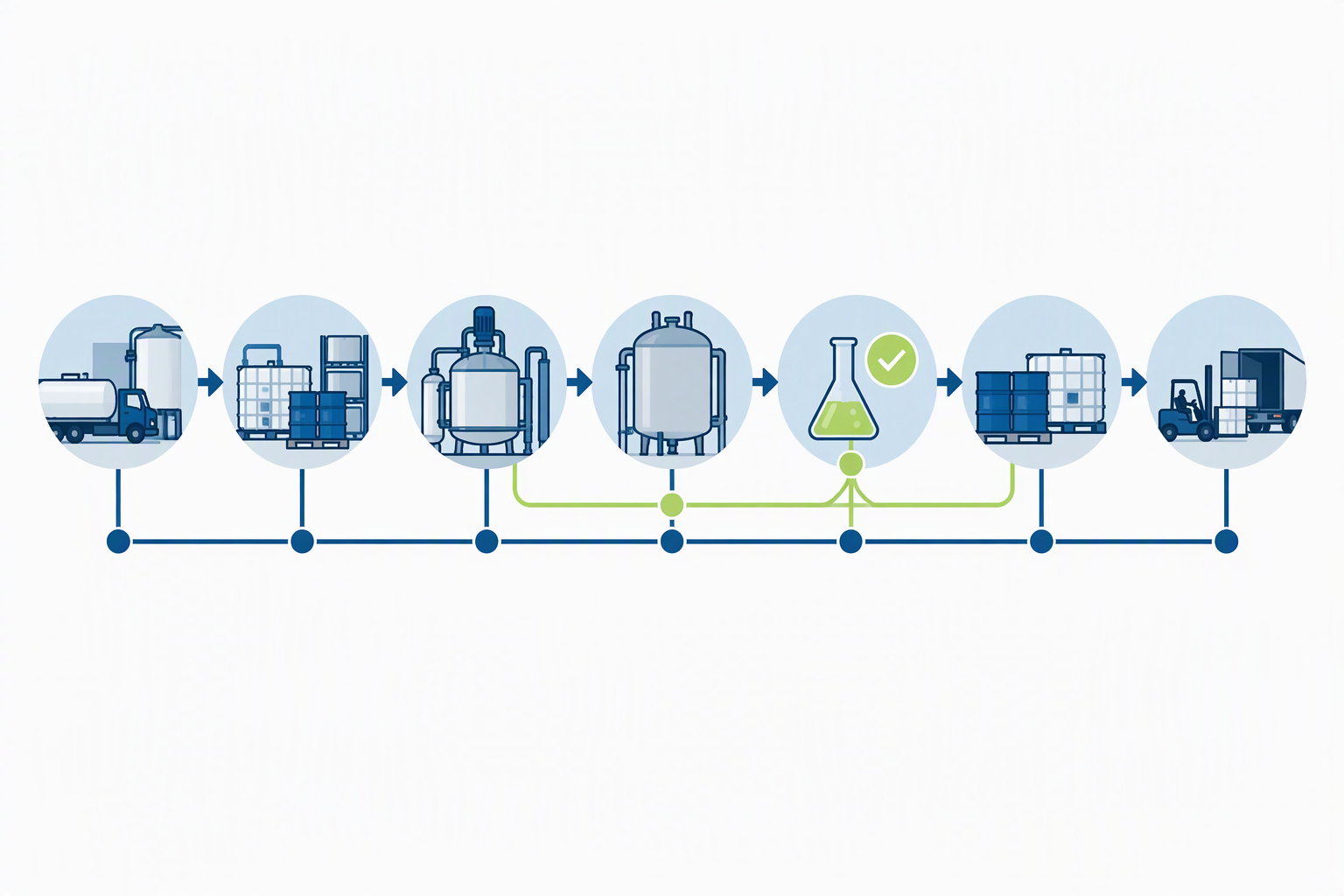
Business Central can serve as the transactional core connecting purchasing, inventory, manufacturing, warehousing, costing, sales, and financial activity. Specialized applications can then complement that core where deeper industry functionality is required.
The result is not necessarily one system. It’s one connected operational picture.
The connection begins when ingredients enter the operation. Chemical manufacturers frequently need visibility beyond simply knowing the quantity of an ingredient on hand. Operational teams may also care about:
When purchasing and inventory transactions are connected to a common ERP foundation, organizations establish the first part of the manufacturing data chain. This becomes especially important when a particular raw material must later be connected to the batches in which it was consumed.
Inventory and production shouldn’t operate as independent processes. Manufacturing changes inventory. Raw materials are consumed. Intermediate or finished products are produced. Actual material usage may vary from expectations.
A connected ERP environment lets the manufacturing transaction and inventory transaction become parts of the same operational history. For executives, this improves the organization’s ability to answer questions such as:
The benefit isn’t simply better production reporting. It’s connecting production activity to its inventory consequences.
Production can tell you that a batch was manufactured. Quality can tell you whether that batch met established requirements. Those two things need context.
Depending on the manufacturer’s quality model, information associated with a batch might include:
Not every one of these processes necessarily belongs inside standard Business Central. The important architectural principle is that quality information should retain a connection to the ERP transactions and batch identities it describes.
A quality result without a reliable relationship to the material or production batch has limited operational value. Likewise, production data without visibility into relevant quality status can leave other teams working with incomplete information.
Suppose production has completed a batch, but the organization’s quality process has not yet determined whether that product should be available for its next intended use. Production sees completed output. Inventory sees quantity. Quality has additional information necessary for the business process.
If those processes aren’t connected, different departments can interpret the same inventory differently. A mature operating model establishes clear relationships between:
What was produced → What was evaluated → What is available for the next business process
The exact technical implementation depends on the manufacturer’s requirements and quality solution architecture. The important executive consideration is that inventory availability and quality processes shouldn’t become disconnected operational decisions.
Once quality, manufacturing, and inventory share common identifiers, traceability becomes significantly more useful. Consider a quality issue involving one ingredient lot. The organization may need to move through:
Supplier Lot → Raw Material Inventory → Production Consumption → Manufactured Batch → Finished Inventory → Customer Shipment
Traceability provides the genealogy. Connected quality information provides additional context around that genealogy. Together, they help the business understand not merely where material traveled, but what operational information is associated with it.
Quality and production issues eventually become financial issues. Examples can include:
If operational and financial information live in entirely separate environments, management can see a problem without necessarily seeing its business impact.
Using Business Central as the ERP backbone can bring manufacturing, inventory, purchasing, sales, and finance into the same business system, creating a stronger foundation for connecting operational performance to financial performance.
For a chemical manufacturer, the strongest Business Central architecture isn’t “Put everything in the ERP.” Instead, it is “Use Business Central as the transactional backbone and connect the specialized processes that need to interact with it.”

For chemical manufacturers, this provides an important operational foundation around which specialized quality, laboratory, formulation, or compliance capabilities can be designed.
Standard Business Central should not be treated as a complete chemical-industry Quality Management System or Laboratory Information Management System simply because it manages manufacturing and inventory.
Chemical manufacturers may have requirements involving:
Depending on requirements, those processes may be addressed through Business Central extensions, integrations, Microsoft Power Platform solutions, or purpose-built applications. The important objective is integration.
A laboratory system shouldn’t need to independently recreate the entire manufacturing transaction history just to understand what it is testing. Likewise, ERP users shouldn’t need to manually re-enter critical quality information simply to understand the operational context of a batch.
|
DISCONNECTED
|
CONNECTED
|
|---|---|
|
Quality: Here's what testing found.
|
Quality information is connected to the materials, batches, and transactions it describes.
|
|
Production: Here's what we manufactured.
|
Production is connected to actual materials, inventory, and quality context.
|
|
Inventory: Here's what we have.
|
Inventory retains the manufacturing and quality context needed to understand what happened next.
|
A connected organization can ask: What did we manufacture, what materials went into it, what quality information is associated with it, where is the resulting inventory, and what happened to it next?
Can quality teams easily identify the production and material records associated with a batch?
Can production teams identify the actual material lots associated with manufactured products?
Can inventory records be traced back to the manufacturing activity that created them?
Can we move both backward and forward through material and production history?
Are employees manually transferring information between ERP, quality systems, spreadsheets, and other applications?
Can management connect manufacturing and inventory activity to its financial consequences?
When something goes wrong, how many systems and departments are required before management understands the complete picture?
Those answers provide a useful indicator of how connected the manufacturing operation really is.
Chemical manufacturers don’t necessarily need every operational function in one application. They need their critical information connected.
Quality needs production context. Production needs material visibility. Inventory needs manufacturing context. Finance needs the consequences of all three.
For organizations building their manufacturing platform around Microsoft Dynamics 365 Business Central, ERP can become the transactional foundation connecting purchasing, inventory, manufacturing, warehouse activity, sales, and financial management while complementary applications address specialized chemical-industry requirements.
The strategic objective is straightforward:
Connect what you buy, what you make, what you test, what you have, what you ship, and what it costs.
That’s when manufacturing data stops being a collection of records and starts becoming useful business information.








Whether you’re evaluating a new ERP platform, planning an upgrade, or improving your manufacturing operations, a Manufacturing Strategy Session can help identify opportunities to improve visibility, operational performance, and determine the right path forward.
