Managing Remnants and Partial Material Consumption in Specialty Metals Manufacturing
How specialty metals manufacturers can improve material utilization, inventory visibility, and profitability with Microsoft Dynamics 365 Business Central.
In specialty metals manufacturing, inventory is rarely as simple as receiving a unit, consuming a unit, and shipping a unit. A bar may be cut several times before it is completely consumed. A portion of plate may remain usable after a production order. Tube, sheet, coil, billet, or other material may return to inventory with different dimensions than when it was originally received.
When those materials involve titanium, nickel-based alloys, stainless steel, cobalt alloys, or other high-value metals, the financial significance can be substantial.
Specialty metals manufacturers are increasingly treating remnant management and partial material consumption as part of inventory control, production execution, traceability, and profitability rather than simply as a shop-floor problem. For organizations running Microsoft Dynamics 365 Business Central, ERP can provide the transactional foundation for connecting purchasing, inventory, manufacturing, costing, and lot tracking, with industry-specific extensions or processes added where dimensional inventory and remnant requirements go beyond standard functionality.
Can you find and use the material you already own?
How much usable material remains, where is it, what is it, and can we confidently use it on another order?
The Industry Challenge: A Pound Is Not Always Just a Pound
Traditional inventory systems are often designed around quantities. Specialty metals manufacturers need something more nuanced.
Consider two pieces of the same alloy that each weigh the same amount. One might be a long, usable remnant capable of satisfying an upcoming production requirement. The other might consist of material whose remaining dimensions make it impractical for that job. From a purely quantitative inventory perspective, they may appear equivalent. Operationally, they are not.
A manufacturer needs to understand not only how much material is available, but potentially:
What material it is
Its physical form
Its remaining dimensions
Where it is located
Its lot or heat identity
What material has already been consumed
Whether the remainder is usable
What production requirements it could potentially satisfy
Without that visibility, valuable inventory can effectively disappear from the planning process even though it remains physically present in the plant.
Where Partial Material Consumption Creates Complexity
Consider a manufacturer purchasing specialty alloy bar. The original bar is 144 inches, and a production job consumes 62 inches. After cutting and accounting for processing, usable material may remain.
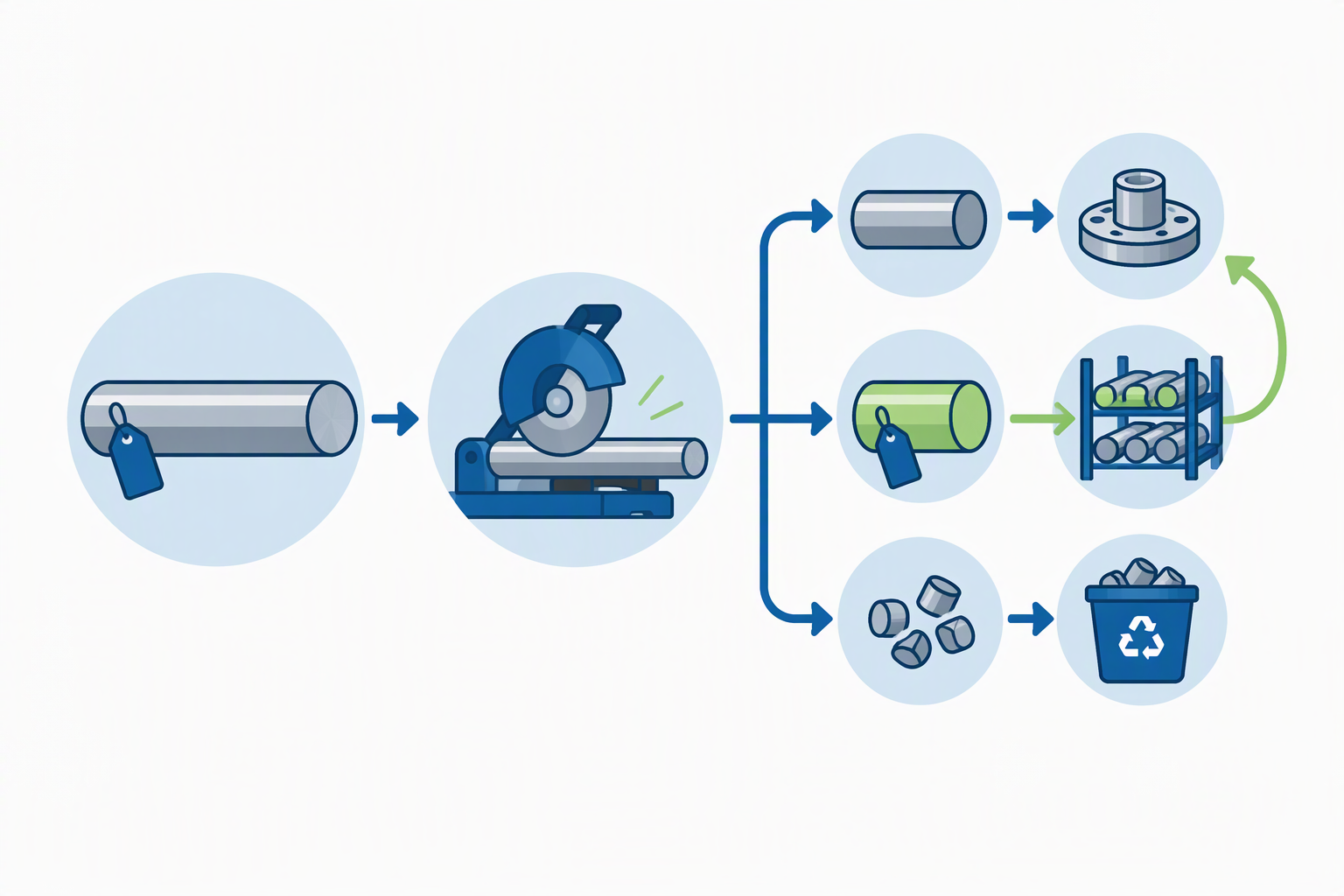
The business now has an important decision: is the remaining material still inventory? If it can be used on a future production order, the answer is yes. But the inventory has changed. The manufacturer didn’t simply consume a percentage of an abstract item. It transformed one physical piece into:
Consumed Material + Usable Remnant + Potential Scrap
That distinction matters operationally and financially.
Building Material Utilization Control
1. Maintain Visibility Into the Original Material
Effective remnant management starts before the first cut occurs. The incoming material needs a reliable inventory identity. Depending on the operation, relevant information may include:
Alloy or grade
Material form
Quantity or weight
Dimensions
Lot or heat number
Supplier
Location
Certification information
Business Central can provide the ERP foundation for purchasing, receiving, inventory management, item tracking, warehousing, and costing. However, specialty metals manufacturers frequently have dimensional or attribute requirements that require additional design beyond a basic item-and-quantity inventory model.
The objective isn’t simply to know “We have 600 pounds of this alloy.” It is to understand whether the physical inventory represented by those 600 pounds can satisfy actual manufacturing demand.
2. Record What Production Actually Consumes
Production standards can describe what a job is expected to consume. Actual manufacturing may tell a different story. When material is cut, processed, or issued to production, the system needs to reflect the material that was actually consumed. That creates a better foundation for understanding:
Material usage
Production variance
Yield
Scrap
Job cost
Material availability
For executives, inaccurate consumption affects more than warehouse quantities. It can distort product cost and inventory value while hiding opportunities for future material reuse.
3. Return Usable Remnants to Visible Inventory
One of the biggest opportunities is ensuring that usable remnants don’t disappear into a rack and a spreadsheet. If a remaining piece has economic and production value, it needs to remain visible to the business:
Original Material → Partial Consumption → Remaining Material → Usable Remnant → Future Production
The precise ERP design depends heavily on how the manufacturer buys, measures, consumes, identifies, and reuses material. But the business principle is straightforward: if a remnant is valuable enough to save, it should be manageable enough to find and use. Otherwise, the organization can end up purchasing new material while suitable remnants are already sitting in inventory.
4. Preserve Traceability When Material Is Split
For specialty metals manufacturers, simply knowing that a remnant exists may not be enough. Material identity can matter just as much as quantity. When traceability requirements apply, a remnant created from a parent piece may still need to retain a relationship to its original lot or heat.
This becomes especially important in environments serving customers with strict material-certification and traceability requirements. Changing the size of the material should not automatically mean losing its identity. The inventory design for remnants needs to consider traceability alongside quantity and dimensional information.
5. Make Remnants Available to Planning
If production planning cannot see or meaningfully evaluate existing remnants, the manufacturer can still purchase material unnecessarily. Before purchasing another full piece, the organization should be able to evaluate:
Do we already have suitable material?
Is there a remnant that can satisfy this requirement?
Is it the correct alloy?
Does it meet the required dimensions?
Is the material identity acceptable for the job?
Where is it physically located?
This can turn remnant inventory from a passive asset into a usable planning resource.
6. Separate Usable Remnants from Scrap
Not every leftover piece should remain available indefinitely. At some point, a remnant may no longer have enough practical value to justify storage, identification, handling, and inventory management. Specialty metals manufacturers therefore need policies around what constitutes:
A usable remnant
Recoverable scrap
Waste
Inventory requiring review
Those decisions are specific to the manufacturer’s materials, processes, economics, and customer requirements. The important issue for executives is consistency. Without clear rules, plants tend to accumulate large amounts of material whose theoretical inventory value does not correspond to realistic production value.
7. Connect Remnants to Cost and Profitability
Remnant management ultimately becomes a financial-management issue. Consider two scenarios:
REMNANT IS LOST
REMNANT IS CONTROLLED
→
A job partially consumes an expensive piece of material, and the remainder physically exists but isn't visible or readily reusable.
→
The usable remainder stays identifiable and visible as controlled inventory.
→
Another job later requires similar material, and purchasing buys another full piece.
→
A future requirement can potentially consume the remnant rather than purchasing additional material.
The difference affects:
Inventory investment
Material utilization
Purchasing requirements
Scrap exposure
Job cost
Margin
For expensive specialty metals, material utilization is a profitability issue, not a warehouse-detail problem.
The Role of Microsoft Dynamics 365 Business Central
For specialty metals manufacturers, Business Central can provide the core ERP environment connecting:
Purchasing: Maintain purchasing transactions associated with raw material acquisition.
Inventory: Provide the transactional foundation for quantities, locations, movements, consumption, and valuation.
Item Tracking: Support lot-based material identity where traceability is required.
Manufacturing: Connect material requirements and actual consumption with production activity and output.
Warehousing: Connect physical storage and movement with ERP inventory.
Costing: Reflect material and manufacturing activity in product and inventory cost.
Financial Management: Connect operational activity with the financial performance of the business.
The important implementation consideration is recognizing where standard inventory functionality ends and specialty-metal requirements begin.
Where Specialty Metals Requirements Go Beyond Standard ERP
Standard ERP functionality does not automatically understand every characteristic of a piece of specialty metal. A metals manufacturer may need additional capabilities for areas such as:
Length, width, and thickness
Diameter
Piece-level identification
Variable-length inventory
Catch-weight scenarios
Dimensional inventory
Remnant creation
Remnant selection
Material nesting or cutting optimization
Heat and certification information
Specialized material genealogy
These requirements need to be evaluated during solution design. Depending on the operation, they may be addressed with Business Central configuration, extensions, industry solutions, integrations, or purpose-built functionality.
Business Central provides the ERP foundation, while the solution is designed around the way specialty metals are actually purchased, consumed, tracked, and reused.
From Quantity Management to Material Utilization
QUANTITY MANAGEMENT
MATERIAL UTILIZATION
→
How much material do we have?
→
What usable material do we have, and how much value can we recover from the material we've already purchased?
That moves the conversation from inventory accuracy to material utilization and ultimately to profitability.
Questions Specialty Metals Executives Should Ask
Inventory
Can we identify usable remnants without physically searching the plant?
Dimensions
Do we know enough about remaining material to determine whether it can satisfy another requirement?
Consumption
Does our system distinguish what production actually consumed from what remains usable?
Traceability
When material is split or partially consumed, can we preserve the identity needed by our customer and quality processes?
Planning
Can planners consider existing remnants before generating additional purchasing demand?
Scrap
Do we have a consistent process for deciding when a remnant is inventory versus scrap?
Cost
Are usable remnants accurately represented in inventory and manufacturing economics?
Purchasing
How often do we buy material that could potentially have been satisfied from existing stock?
If several of those questions are difficult to answer, the organization may have accurate inventory totals without having effective material utilization control.
The Executive Takeaway
In specialty metals manufacturing, inventory value doesn’t disappear simply because a full piece has been partially consumed. The material may still exist. The question is whether the business can identify it, find it, value it, trace it, and use it again.
For manufacturers building their operational platform around Microsoft Dynamics 365 Business Central, ERP can provide the foundation connecting purchasing, inventory, manufacturing, costing, warehousing, traceability, and finance. Specialty capabilities can then extend that foundation to accommodate dimensions, remnants, variable material characteristics, and other metals-specific requirements.
The strategic objective is simple:
Know what material you purchased, what production consumed, what remains, and whether that remainder can create value on the next job.
For specialty metals manufacturers, that’s not simply better inventory management. It’s better material economics.
How plastics manufacturers are connecting production, people, materials, quality, and inventory with Microsoft Dynamics 365 Business Central and mobile data collection.
Ready to improve visibility,
reduce operational complexity and build a stronger foundation for growth?
Whether you’re evaluating a new ERP platform, planning an upgrade, or improving your manufacturing operations, a Manufacturing Strategy Session can help identify opportunities to improve visibility, operational performance, and determine the right path forward.