



Business Central

Case Studies
Plastics Manufacturing
Achieving End-to-End Lot Traceability in Plastics Manufacturing
An Industry Case Study for Manufacturing Executives — Powered by Microsoft Dynamics 365 Business Central

How plastics manufacturers are connecting production, people, materials, quality, and inventory with Microsoft Dynamics 365 Business Central and mobile data collection.
This is an industry-wide perspective covering general plastics manufacturing—including molding, extrusion, blow molding, thermoforming, compounding, converting, secondary operations, and packaging. It describes common operating patterns, leading practices, and measurable objectives rather than the results of one named company.
Production visibility is becoming a strategic requirement for plastics manufacturers. The industry must coordinate volatile material demand, short production runs, changeovers, quality requirements, constrained equipment, labor availability, regrind, customer priorities, and increasingly complex traceability. In 2025, U.S. plastics production experienced pronounced cyclical volatility, while average plastics-products capacity utilization fell from 75.0% in 2024 to 73.4% in 2025—conditions that make accurate capacity, inventory, and production-status information especially valuable.
The challenge is rarely a complete absence of data. Most plants already generate production orders, machine counts, inspection results, downtime notes, inventory transactions, labor records, and shipping information. The problem is that these records are often captured at different times, in different systems, and with different definitions. Plastics-industry research identifies integrated ERP, MES, and QMS platforms, enterprise dashboards, and exception-based workflows as increasingly important ways to centralize this information and make it available to the right people at the right time.
Microsoft Dynamics 365 Business Central provides the operational backbone for this transition. Its manufacturing capabilities connect production BOMs, routings, work and machine centers, production orders, consumption, output, scrap, operation time, capacity, inventory, warehousing, quality, costing, and analytics. Microsoft’s manufacturing model is designed to help organizations plan, schedule, execute, and analyze production while updating inventory and cost records as production activity is recorded.
Naviona Shop Floor & Warehouse Mobile extends that backbone to the point of work. Operators and warehouse personnel can use barcode scanners, tablets, smartphones, and mobile computers to record manufacturing, inventory, and warehouse activity rather than relying on paper followed by delayed entry. Supported activities include starting and stopping operations, capturing labor time and downtime, posting consumption, output, scrap and rejects, receiving, put-away, picking, movements, transfers, counts, barcode capture, and rule-based label printing.
How can plastics manufacturers reduce the time between a physical event on the shop floor and its visibility to the people who must respond?
A typical plastics operation may have sophisticated processing equipment while still depending on paper travelers, whiteboards, spreadsheets, shift reports, stand-alone machine controls, and manual ERP posting. Consequently, leadership may know what was planned but not what is happening now—or may see actual results only after a shift or production run is complete. Plastics-industry sources describe this gap as a major reason processors are integrating planning, production monitoring, quality, and inventory information.
| Executive concern | Common visibility gap | Business consequence |
|---|---|---|
| Production tracking | Started, paused, completed, and partially completed operations are not updated promptly. | Production status and expected completion dates become difficult to trust. |
| Labor reporting | Setup, run, indirect, and downtime hours are captured at shift end or reconstructed later. | Labor and capacity costs can diverge from actual work. |
| Machine utilization | Planners see scheduled load but not current operating status or actual elapsed time. | Available capacity, bottlenecks, and schedule risk remain hidden. |
| Inventory accuracy | Resin, additives, colorant, components, packaging, WIP, and finished output are posted after movement or consumption. | Shortages appear unexpectedly and system inventory differs from physical inventory. |
| Quality control | Inspection results, rejects, holds, and dispositions reside outside the production record. | Suspect product can be difficult to contain or investigate. |
| Downtime visibility | Stops are documented inconsistently or without structured reason attribution. | Management sees lost output without understanding where corrective action is needed. |
| Traceability | Supplier lots, internal lots, consumption, output, and shipments are recorded in separate places. | Root-cause analysis and customer response become reconciliation exercises. |
| Scheduling responsiveness | Machine, tooling, labor, quality, and material changes do not immediately reach planning. | Planners repeatedly rebuild schedules using outdated assumptions. |
| Executive decision-making | Reports summarize the past rather than exposing current exceptions. | Leaders react after cost, delay, or scrap has already accumulated. |
This is particularly consequential in plastics because production feasibility can depend simultaneously on resin and additive availability, machine capability, tooling, color or material sequence, setup labor, secondary operations, quality status, packaging capacity, and customer priority. Integrated ERP and MES approaches allow work orders and planning information to flow to the floor while completed quantities, scrap, consumption, and production time flow back to the enterprise system.
Leading manufacturers are moving toward an operating model in which the production plan, shop-floor execution, inventory movements, quality decisions, and management analytics share a common transaction foundation. The objective is not simply “more data.” It is to reduce the time between a physical event and its visibility to the people who must respond.
A connected production-visibility loop follows five principles:
Together, physical activity, mobile execution, Business Central, and analytics form one closed information loop. Business Central supplies governed production and inventory records; Naviona Shop Floor & Warehouse Mobile captures execution events; and Power BI surfaces utilization, work-center load, production status, scrap, and variance information.
Plan from Governed Data → Release Executable Work → Capture Activity at the Source → Update the Operational Record → Replan and Manage by Exception
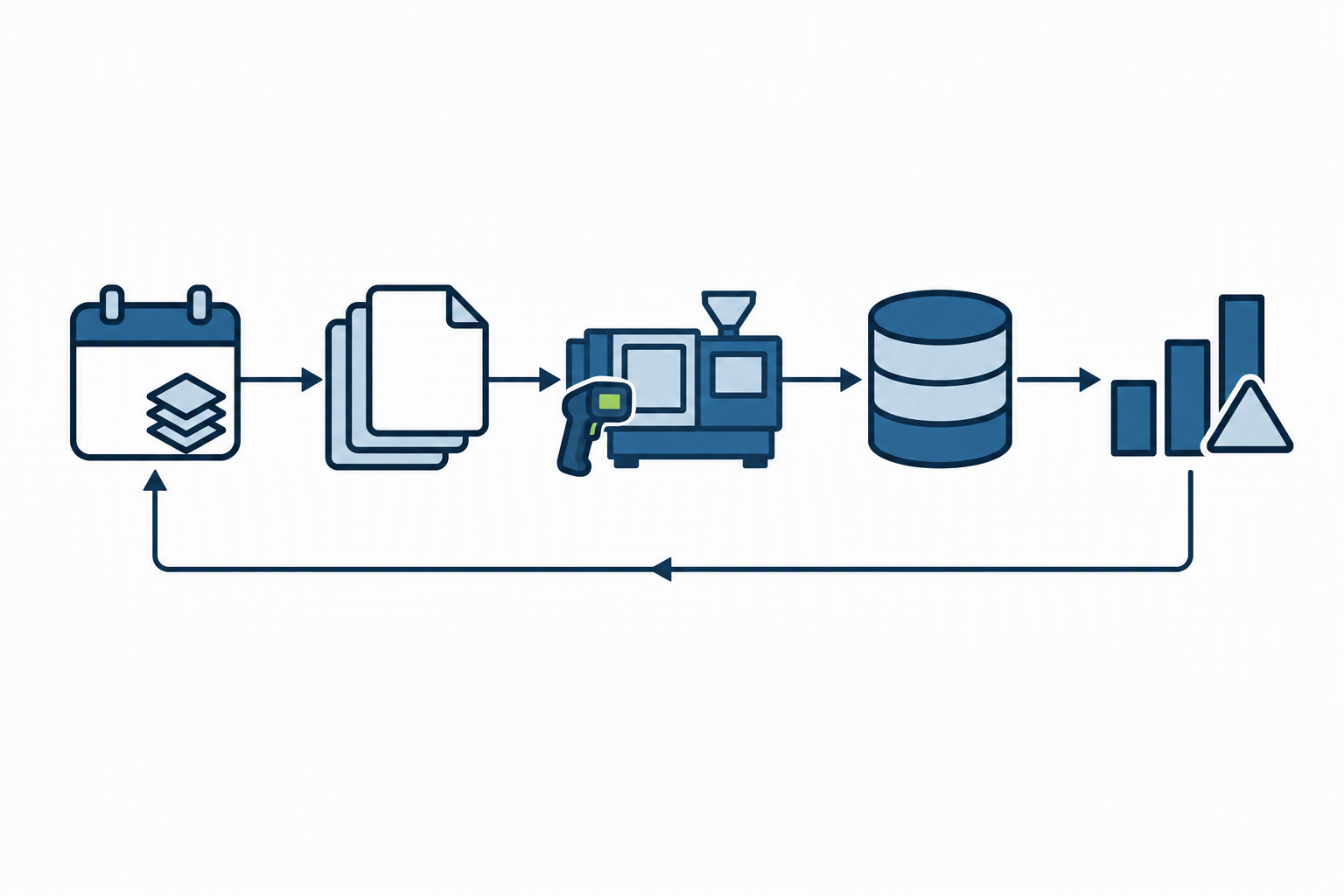
Business Central’s value is not that it replaces every machine controller, historian, laboratory system, or specialized MES requirement. Its strategic role is to maintain the shared business record connecting production execution with inventory, purchasing, warehousing, customer demand, costing, and financial outcomes.
These reports turn Business Central transactions into role-relevant views for executives, plant managers, supervisors, and production teams.
Naviona Shop Floor & Warehouse Mobile brings Business Central transactions closer to the shop floor and warehouse. Rather than asking operators to leave their work area, complete paperwork, or wait for someone else to post activity, the solution enables execution from scanners, tablets, smartphones, and mobile computers.
Relevant capabilities include:
Output screens can expose bin, lot, serial, and expiration information when required, while consumption screens can request bin, lot, or serial information for components. This links material identity to the production transaction at the moment consumption or output is recorded rather than reconstructing the relationship later.
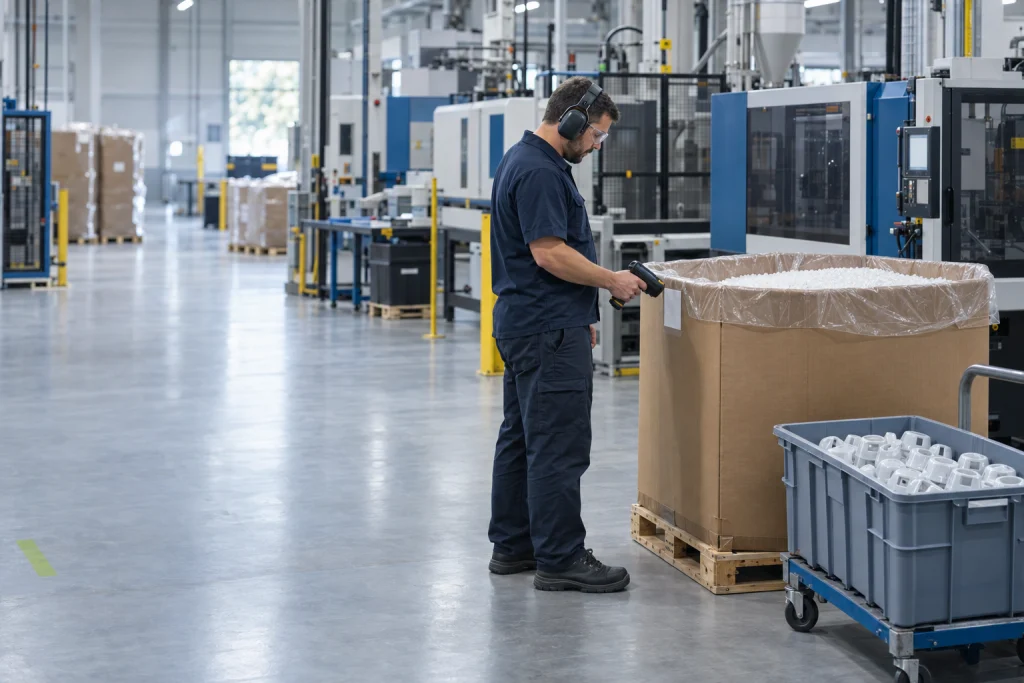
Naviona Shop Floor & Warehouse Mobile supports receiving, put-away, picking, movements, transfers, warehouse shipments, inventory counts, and barcode-driven inventory transactions. Mobile workflows can operate on tablets, scanners, or phones and update Business Central as warehouse activity is completed.
Physical inventory counts can be performed by scanning item, bin, lot, or serial information and entering the observed quantity. The resulting difference may be posted automatically or placed in an inventory journal for review. Inventory adjustments similarly support barcode-based item, bin, lot, and serial capture, providing a controlled way to reconcile physical and system inventory.
Business Central is the operational and financial foundation, not a replacement for every specialized plant system. More specialized laboratory, SPC, or machine-parameter requirements may still warrant a connected QMS, LIMS, MES, or historian rather than forcing every measurement into ERP.
Similarly, available Naviona documentation supports employee-attributed production time, setup/run-time capture, operation start/stop, and downtime reporting. Executives requiring broader HR attendance functions—such as payroll clock-in/out, leave, or absence management—should evaluate those requirements separately rather than assuming production-time capture is a complete workforce-management system.
Improved visibility should be evaluated through operational measures, not generalized software promises. A Deloitte survey of 600 large-manufacturer executives reported average improvements of 10%–20% in production output, 7%–20% in employee productivity, and 10%–15% in unlocked capacity from smart-manufacturing initiatives; these are broad manufacturing findings, not guaranteed plastics or Business Central results.
| Desired outcome | How improved visibility contributes | Executive measures |
|---|---|---|
| Higher productivity | Less time spent locating orders, reconciling reports, and re-entering production data | Output per labor hour; administrative reporting time |
| Shorter reporting latency | Activity is captured when work starts, stops, consumes material, or produces output | Time from physical event to ERP transaction |
| Improved inventory accuracy | Barcode-driven movements, counts, consumption, and output keep locations and quantities current | Inventory accuracy; unexplained adjustments; shortage incidents |
| Better scheduling decisions | Actual progress, material usage, downtime, and work-center load inform replanning | Schedule adherence; replanning time; late production orders |
| Enhanced traceability | Lot and serial data follow consumption, production output, warehouse movement, and shipment | Trace completeness; investigation time; recall-drill performance |
| Reduced downtime exposure | Structured start/stop and downtime information identifies where productive time is being lost | Downtime by reason; MTTR; availability; lost production hours |
| Faster issue response | Dashboards and exception views expose delays, scrap, quality holds, and overloaded resources | Exception age; escalation-to-resolution time |
| Stronger cost visibility | Actual material, labor, capacity, scrap, and output transactions support variance and production-cost analysis | Consumption variance; capacity variance; scrap cost; margin variance |
|
PERIODIC REPORTING
|
CONNECTED EXECUTION LOOP
|
|---|---|
|
Operations, labor, and output are captured at shift end or reconstructed later
|
Activity is captured when work starts, stops, consumes material, or produces output
|
|
Resin, additives, components, WIP, and finished output are posted after movement or consumption
|
Barcode-driven movements, counts, consumption, and output keep locations and quantities current
|
|
Supplier lots, internal lots, consumption, output, and shipments are recorded in separate places
|
Lot and serial data follow consumption, production output, warehouse movement, and shipment
|
|
Reports summarize the past rather than exposing current exceptions
|
Dashboards and exception views expose delays, scrap, quality holds, and overloaded resources
|
These outcomes depend on operating discipline. Timely mobile capture cannot compensate for incorrect BOMs, routings, units of measure, work-center calendars, item-tracking rules, or production-order practices. Industry sources consistently emphasize data verification, standardized definitions, training, and integration design as prerequisites for reliable production insight.
Define which system governs production orders, inventory, lot identity, quality disposition, cost, and financial results. Avoid competing versions of quantity, status, or completion stored in spreadsheets, machine systems, and ERP.
Identify the decisions that arrive too late today: material shortages, production delays, machine downtime, excess scrap, quality holds, or capacity overload. Design data capture around shortening the time from event to action.
Begin with operation start/stop, material consumption, production output, scrap, downtime, receiving, put-away, production staging, inventory counts, finished-goods movement, and shipment. These events influence several downstream functions and are supported by Business Central and Naviona Shop Floor & Warehouse Mobile.
Agree on what constitutes setup time, run time, downtime, good output, scrap, rework, finished output, and completed operation. Without shared definitions, faster reporting only distributes inconsistent information sooner.
Business Central should govern operational and financial transactions. Naviona Shop Floor & Warehouse Mobile should capture human-directed production and warehouse activity at the point of work. High-frequency temperature, pressure, cycle, energy, and condition-monitoring data may remain in MES, SCADA, PLC, or historian platforms, connected through common order, operation, machine, and lot identifiers.
Baseline posting latency, inventory accuracy, schedule adherence, labor-reporting completeness, downtime categorization, trace completeness, scrap, and investigation time before deployment. Review adoption and business performance together.
For plastics manufacturers, shop-floor visibility is no longer simply a supervisor’s reporting concern. It is the connective tissue between production, inventory, scheduling, quality, traceability, cost, customer service, and executive decision-making.
Microsoft Dynamics 365 Business Central provides the shared manufacturing and business record. Naviona Shop Floor & Warehouse Mobile extends that record to scanners, tablets, smartphones, and mobile computers so production and warehouse activity can be recorded where it occurs. Power BI then turns the resulting transactions into utilization, load, variance, scrap, production-status, and WIP insight.
The strategic shift is straightforward but consequential: from reconstructing yesterday’s production to managing today’s exceptions.




Whether you’re evaluating a new ERP platform, planning an upgrade, or improving your manufacturing operations, a Manufacturing Strategy Session can help identify opportunities to improve visibility, operational performance, and determine the right path forward.
