This is a composite, evidence-based industry case study. It describes practices used across mills, foundries, service centers, processors, fabricators, and component manufacturers—not the results of one named company. Requirements vary by product, customer, contract, jurisdiction, and end market; manufacturers should validate the obligations applicable to each program.
In specialty metals, the material is only part of the product. The evidence that proves what the material is, where it originated, how it was processed, and where it was delivered is part of the product too. ASTM E3315 formalizes terminology and information requirements for metallic-material certifications, including melt mill, traceability, heat versus lot number, and certificate of compliance. Aviation guidance similarly treats identification, documentation, segregation, and traceability as interconnected controls rather than isolated paperwork tasks.
The industry is therefore moving beyond “mill certificates on file” toward a connected genealogy linking the physical material, mill heat, Material Test Report (MTR), internal inventory identity, processing history, quality status, finished lot or serial number, and customer shipment. This model supports both compliance and operational performance: an incoming heat can be traced forward to inventory, work in process, finished goods, and customers, while any shipment can be traced backward to its contributing material and certifications.
Microsoft Dynamics 365 Business Central can provide the transactional backbone for this operating model. It supports serial, lot, and package tracking on inbound and outbound documents, carries posted tracking information into item-ledger entries, preserves tracking through transfers, and provides forward and backward Item Tracing. Its Quality Management extension, introduced in 2026 release wave 1, adds inspection generation, lot blocking, quarantine-related actions, and workflow integration.
Can you trace it both ways?
Could you trace one recently shipped lot backward to every contributing heat and certificate, and one incoming heat forward to every remaining piece, remnant, work order, finished lot, outside processor, and customer shipment, without a manual gap?
The Industry Challenge: High-Value Material, High-Cost Uncertainty
Specialty metals routinely change form—from ingot, billet, slab, coil, plate, bar, tube, wire, forging, or casting into blanks, slit coils, cut lengths, machined components, remnants, heat-treated material, coated products, and finished assemblies. Each split, merge, transfer, or outside-processing event creates an opportunity for the physical product to become disconnected from its heat identity and certification evidence. Metals guidance consistently identifies cutting, relabeling, mixed storage, certificate matching, and remnant handling as critical points in the chain of custody.
An MTR normally establishes the source heat and reports material information such as chemistry, mechanical properties, grade, specification, and test results. But possession of an MTR does not by itself prove that the certificate belongs to the stock issued to a job or shipped to a customer.
The control that matters is the unambiguous relationship between the document, the marked material, the inventory transaction, and the resulting product.
That distinction explains why material genealogy is simultaneously a compliance capability and an operational capability. When the relationship is intact, organizations can isolate a specific heat, protect unaffected inventory, retrieve the correct documents, and investigate quality incidents. When it is broken, quality and operations must reconstruct history across paper travelers, spreadsheets, emails, ERP transactions, shared folders, and employee knowledge.
The North American Drivers
Aerospace and Aviation
FAA Advisory Circular 20-154A recommends receiving-inspection systems capable of establishing identification and traceability, matching part, model, serial, packing, certification, and purchase information, segregating questionable material, and maintaining batch identity for bulk quantities. The FAA explicitly notes that this circular is guidance—one acceptable approach rather than a regulation by itself.
In Canada, Transport Canada AC 571-024 defines traceability as the ability to trace a part’s history or origin to the manufacturer or maintainer that last certified it. It identifies effectivity, condition, traceability, and documentation as the four elements to establish before a part is considered eligible for installation, and recognizes certified copies and controlled electronic documentation when bulk shipments are split.
Defense
For applicable U.S. Department of Defense contracts, DFARS 252.225-7009 restricts covered specialty metals incorporated in delivered items unless they were melted or produced in the United States, an outlying area, or a qualifying country, subject to defined exceptions. The clause covers categories including certain steels, nickel and iron-nickel alloys, cobalt alloys, titanium alloys, and zirconium alloys, and requires relevant substance to flow into subcontracts.
Heat-level provenance is therefore a practical evidence foundation for defense programs—but heat tracking alone does not establish DFARS compliance. Applicability, qualifying-country status, contract language, exceptions, product form, and supplier flow-down must also be evaluated.
Energy, Pipeline, and Pressure Equipment
For applicable onshore steel transmission pipelines, 49 CFR 192.607 requires specified material-property records to be maintained for the life of the pipeline and to be “traceable, verifiable, and complete.” Where those records do not exist, the rule requires procedures for verification through examinations, nondestructive tests, or destructive tests under the specified conditions.
Canadian pressure-equipment requirements vary by province. In Ontario, for example, TSSA requires qualifying manufacturers of boilers, pressure vessels, fittings, and piping systems to maintain an approved quality program, undergo an audit, and comply with applicable provincial, CSA, and ASME requirements. This reinforces the broader industry need to connect material identity, approved procedures, inspection, and manufacturing evidence.
Medical Devices
The FDA Quality Management System Regulation became effective February 2, 2026, incorporating ISO 13485:2016 by reference for finished medical-device manufacturers and aligning U.S. requirements more closely with international quality-system practice. FDA device-tracking requirements also apply to certain devices when the FDA orders tracking, supporting prompt location, notification, or recall of devices presenting serious health risks.
Not every specialty-metal supplier is directly regulated as a finished-device manufacturer. In practice, many receive traceability, process-validation, inspection, cleanliness, and record-retention requirements through customer specifications and supplier-quality agreements. Executives should distinguish direct regulatory obligations from contractually flowed-down requirements.
The Executive Implication
There is no single universal genealogy rule for every specialty-metals shipment. The required depth should be driven by the material specification, customer purchase order, quality plan, product code, jurisdiction, end-use risk, and contractual retention requirement. The operating platform must therefore support configurable control—not a one-size-fits-all paperwork process.
The “Before” Environment: Fragmented Traceability
The representative industry starting point is not an absence of traceability data. It is fragmented traceability:
Receiving records the supplier heat in a spreadsheet or handwritten log.
The ERP records quantity and value but not always the exact heat issued.
MTRs are filed by supplier or purchase order rather than indexed by heat.
Cut pieces and remnants are manually remarked.
Production travelers carry handwritten heat references.
Heat-treatment, coating, NDT, and outside-processing certificates reside elsewhere.
Quality status is maintained separately from system availability.
Shipping personnel assemble certificate packages through manual searches.
These practices can preserve individual records while still failing to preserve a complete relationship among them. Published receiving and metals guidance repeatedly emphasizes matching documentation to physical identification, retaining original or certified evidence, controlling bulk splits, segregating questionable material, and preserving traceability during downstream processing.
The Future-State Operating Principle: Connected Genealogy
The modernized industry model treats every custody change and transformation as a genealogy event.
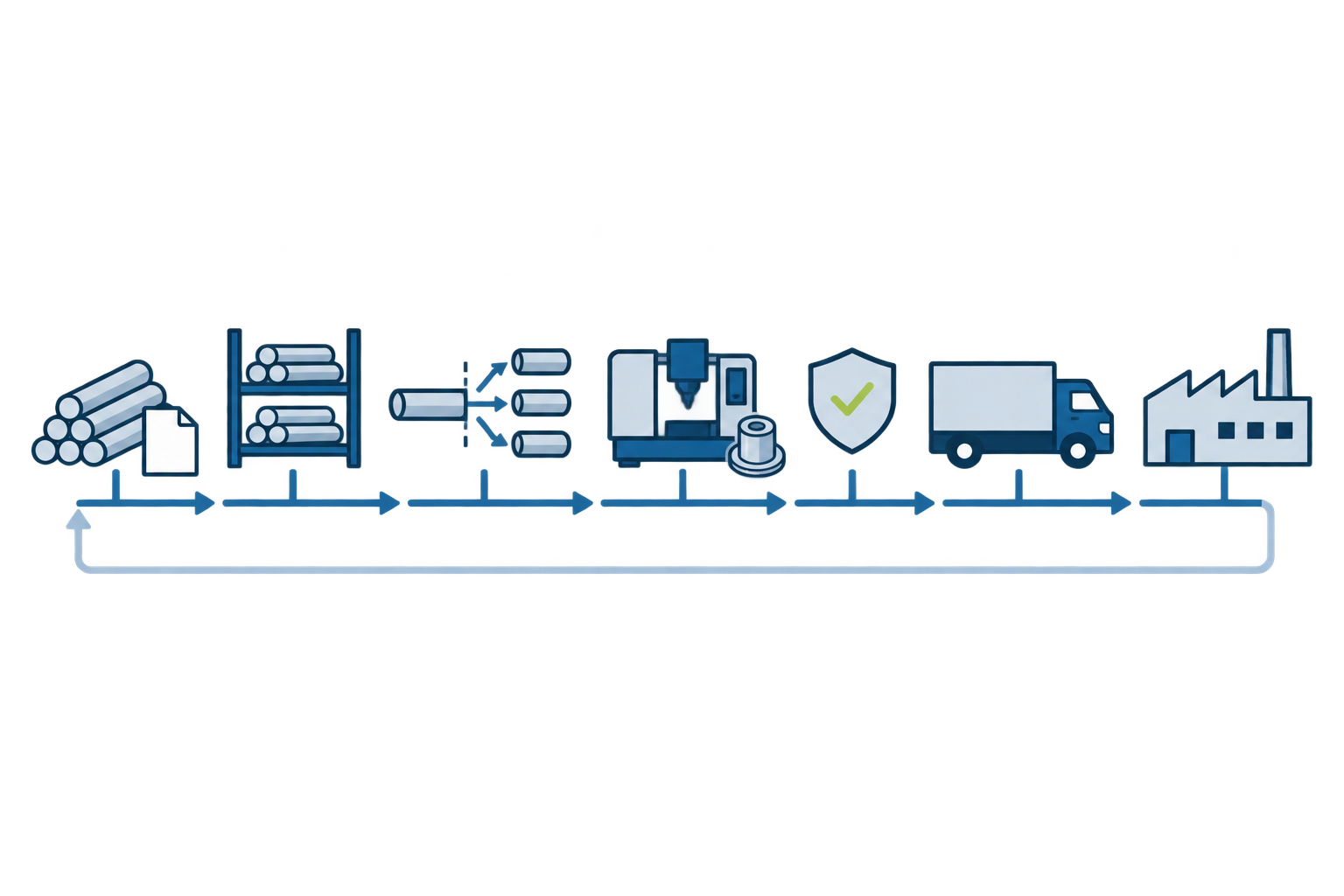
Established at Receipt → Preserved in Storage → Inherited During Splitting → Recorded at Consumption and Output → Connected to Inspection Status → Carried Into the Shipment Record
Business Central becomes the governed transaction layer, while scanning, document management, laboratory, MES, machine, or outside-processor systems provide specialized evidence where required.
How the Connected Model Works
1. Receiving Establishes Identity
At receipt, leading practice is to verify the physical heat marking against the purchase requirement and supporting certificate before unrestricted inventory availability. The receipt record commonly needs the supplier heat, material grade, specification, dimensions, quantity or weight, mill or source information, certificate reference, and inspection disposition appropriate to the program.
In Business Central, the mill heat may be used directly as the Lot No., or the company may create an internal lot that retains a governed cross-reference to the supplier heat. Lot Specific Tracking can require the identified lot entering inventory to follow the item when it leaves inventory, while posted tracking details are carried into item-ledger entries.
2. Warehousing Preserves Physical Separation
Material should remain distinguishable by heat, specification, form, dimension, ownership, and quality status. Barcode or 2D labels make the system identity visible on racks, bundles, coils, containers, and individual remnants. FAA guidance similarly recommends maintaining producer and batch identification, retaining original packaging where practical, and segregating questionable or unserviceable material.
Business Central supports lot, serial, and package identities in receipts, shipments, transfers, journals, and warehouse activities. Its mobile application can scan 1D and 2D barcodes into item-tracking lines, warehouse activity lines, item journals, physical-inventory journals, and Item Tracing pages.
3. Cutting, Slitting, and Remnants Preserve Parentage
Conversion is the highest-risk genealogy breakpoint. When a plate, bar, tube, or master coil is divided, each child piece and usable remnant must inherit the correct parent heat. The transaction should also preserve output quantity or weight, dimensions, scrap, location, and the cutting or production order responsible for the transformation.
Business Central can split tracked quantities across multiple journal lines and reclassify lot numbers, including creating new lot identities or merging lots. However, coil genealogy, catch weight, dimensional inventory, remnant geometry, cut optimization, multi-output conversion, and heat-mixture restrictions may require metals-specific configuration or extensions; these needs should be proven during solution design rather than assumed to be standard capabilities.
4. Production Builds Parent–Child Genealogy
Actual material consumption should identify the input heat issued to the production order, and output posting should create the controlled finished lot or serial number. Outside processing should retain the identity while adding the processor, operation, shipment and return references, heat-treatment lot, NDT report, inspection result, or process certificate required by the program.
Business Central’s manufacturing model connects production BOMs, routings, production orders, component consumption, output, scrap, time, inventory, and cost. Proper posting of tracked input and output creates the transactional relationship that Item Tracing later follows.
5. Quality Status Becomes an Operational Control
A genealogy record is incomplete if the organization knows where material is but cannot prevent nonconforming stock from being consumed or shipped. Quality status must govern availability through inspection-pending, released, blocked, quarantine, conditional-use, rework, rejection, or return processes appropriate to the quality system.
Business Central’s Microsoft-published Quality Management extension can automatically generate inspections at purchase receipt, production or assembly output, and warehouse movement. It supports inspection templates, measurements, pass/fail criteria, lot blocking, workflows, quarantine-bin movement, disposal adjustments, transfers, and vendor returns.
6. Shipping Completes the Evidence Chain
Shipping must select the exact released lot and quantity that satisfy the customer’s specification, source, certification, and segregation requirements. Depending on the contract, the evidence packet may include the MTR, Certificate of Conformance, inspection report, heat-treatment certificate, NDT report, or heat-to-part cross-reference.
Business Central carries the selected lot into outbound documents and item-ledger entries. Manufacturing attachments can be associated with production BOMs, routings, and production orders, although Microsoft documents that attachments are not supported at the component or BOM/routing-version level; specialized document architecture may therefore be necessary for heat-specific MTR and processor-certificate management.
The Role of Microsoft Dynamics 365 Business Central
Business Central maps to each executive requirement as follows, with the design consideration that matters most:
Heat and lot identity: Lot, serial, and package tracking across inbound and outbound transactions. Decide whether the mill heat is the Business Central lot or a cross-referenced external identifier.
Forward and backward genealogy: Item Tracing supports Usage → Origin and Origin → Usage; Find Entries also locates posted and open records. Only applied transactions appear in Item Tracing, so posting and application discipline matter.
Warehouse execution: Receipts, put-aways, picks, transfers, bins, warehouse journals, and barcode scanning. Validate the chosen warehouse configuration against required tracking fields and scan points.
Quality release: Inspection rules, templates, lot blocking, workflows, quarantine, and nonconformance actions, available through the Microsoft-published Quality Management extension introduced in 2026 release wave 1.
Controlled documentation: Incoming Documents, manufacturing attachments, OCR-provider and integration options. Heat-level indexing, controlled revision, retention, and customer packet generation may require an extension or DMS/QMS integration.
Audit visibility: Change Log records selected direct data changes by user and time. Configure selectively; Microsoft cautions that broad tracking can affect performance and database size.
Workflow and alerts: Power Automate can respond to record changes, posted documents, schedules, approvals, and external services. Use it for exception notification and orchestration, not as a substitute for missing source transactions.
Executive analytics: Power BI Manufacturing reports cover utilization, load, variance, scrap, production status, cost, and WIP. Add metals-specific genealogy KPIs because the standard app is not a heat-certification dashboard.
Item Tracing is specifically designed to identify where tracked material came from and which customers received it, while Power BI Manufacturing provides operational reporting across production load, consumption variance, scrap, cost, and WIP. Together, these capabilities allow executives to evaluate traceability and productivity without treating them as separate programs.
Where Metals-Specific Requirements Go Beyond Standard Business Central
The strategic value of Business Central is not that it replaces every laboratory system, machine controller, QMS, MES, document repository, or metals application. Its value is that it can maintain the shared business record connecting purchasing, inventory, production, quality, fulfillment, costing, and finance while providing extension points to surrounding systems.
The strongest implementations recognize where metals-specific requirements require configuration, integration, or ecosystem extensions—especially:
Dimensional inventory and coil conversion: Coil genealogy, catch weight, remnant geometry, cut optimization, multi-output conversion, and heat-mixture restrictions.
Outside processing: Processor, heat-treatment, NDT, and process-certificate evidence tied to the material identity.
Specialized quality evidence: Laboratory, QMS, and inspection records that sit outside the ERP transaction layer.
These needs should be proven during solution design rather than assumed to be standard capabilities.
From Fragmented Traceability to Connected Genealogy
FRAGMENTED TRACEABILITY
CONNECTED GENEALOGY
→
Receiving records the supplier heat in a spreadsheet or handwritten log
→
The physical heat marking is verified against the purchase requirement and certificate, then posted as the tracked lot at receipt
→
MTRs are filed by supplier or purchase order rather than indexed by heat
→
MTRs and processor certificates are indexed by heat and relevant receipt, production, and shipment references
→
Cut pieces and remnants are manually remarked
→
Each child piece and usable remnant inherits the correct parent heat through a posted transaction
→
Quality status is maintained separately from system availability
→
Failed or pending material is prevented from unauthorized consumption or shipment
Every custody change and transformation becomes a genealogy event, so shipping no longer depends on manual searches to assemble the certificate package.
Business Outcomes Executives Should Measure
Because no authoritative source establishes a universal benefit percentage attributable solely to Business Central, modernization should be managed against company-specific baselines rather than promotional benchmarks.
Outcome
Recommended KPI
Faster investigations
Median time to complete both backward and forward trace scenarios
Narrower containment
Percentage of suspect inventory, WIP, and shipments isolated at exact heat level
Audit readiness
Time to produce a complete heat-to-customer evidence package
Inventory confidence
Heat-level book-to-physical accuracy
Remnant control
Count and value of unidentified or incorrectly labeled remnants
Documentation quality
Percentage of shipments released with a complete, correct certificate package
Quality control
Quantity and aging of heats pending inspection, blocked, quarantined, or under deviation
Operational efficiency
Labor hours spent rekeying heat numbers or retrieving certifications
Customer responsiveness
Time required to answer heat-certification and origin inquiries
Scalability
Percentage of genealogy events captured through governed transactions rather than spreadsheets
Executive Recommendations
Define risk-based traceability classes. Specify which materials require heat, lot, serial, package, origin, or part-level control based on contracts and end use.
Use one shared identifier model. Preserve the supplier heat even when an internal lot is created.
Capture genealogy at physical handoffs. Prioritize receipt, release, put-away, issue, split, output, outside-processing return, quarantine, pick, and ship.
Design remnants as inventory, not scrap-shaped exceptions. Each usable remnant needs inherited heat identity, dimensions, quantity or weight, status, and location.
Connect certificates to transactions. Index MTRs and processor certificates by heat and relevant receipt, production, and shipment references—not only by file name.
Make quality status executable. Failed or pending material should be prevented from unauthorized consumption or shipment.
Test both directions. Trace a shipment backward to all contributing heats; then trace one incoming heat forward through stock, WIP, finished goods, and customer deliveries.
Treat exceptions as design requirements. Prove how the solution handles split coils, mixed heats, remnants, returns, rework, co-products, outside processing, unit conversions, and missing certifications.
Measure before and after. Establish investigation time, documentation effort, heat-level accuracy, and exception aging before modernization.
Questions Specialty Metals Executives Should Ask
Identity
What is this material?
Location
Where is it now?
Status
Is it approved for use or shipment?
Transformation
What did it become?
Delivery
Who received it?
The executive objective is not to create more administrative work. It is to make the answer to these five questions reliable.
The Executive Takeaway
North American specialty metals manufacturers are not modernizing genealogy simply to produce a better audit report. They are building an operating capability that preserves material identity through every transformation and makes quality status, customer requirements, inventory, and documentation visible in the same decision process.
Business Central provides a strong ERP foundation through item tracking, production transactions, warehouse execution, quality management, document capabilities, workflows, auditing, analytics, and forward/backward tracing. The strongest implementations also recognize where metals-specific requirements—especially dimensional inventory, coil conversion, remnants, certification packages, outside processing, and specialized quality evidence—require configuration, integration, or ecosystem extensions.
The executive test is simple: select one recently shipped lot. Trace it backward to every contributing heat and certificate. Then select one incoming heat and trace it forward to every remaining piece, remnant, work order, finished lot, outside processor, and customer shipment. Any manual gap identifies the next modernization priority.
Managing Remnants and Partial Material Consumption in Specialty Metals Manufacturing
How specialty metals manufacturers can improve material utilization, inventory visibility, and profitability with Microsoft Dynamics 365 Business Central.
How plastics manufacturers are connecting production, people, materials, quality, and inventory with Microsoft Dynamics 365 Business Central and mobile data collection.
Ready to improve visibility,
reduce operational complexity and build a stronger foundation for growth?
Whether you’re evaluating a new ERP platform, planning an upgrade, or improving your manufacturing operations, a Manufacturing Strategy Session can help identify opportunities to improve visibility, operational performance, and determine the right path forward.